
Why Western Christianity Hates the Body (And Why That's Gnostic, Not Biblical)

Ask a Christian where they’ll spend eternity. Most will say heaven, clouds, harps, floating somewhere beyond the stars. Press them for details and you’ll get vague imagery borrowed from greeting cards and Victorian hymns. Now ask them what Scripture actually says about the end of all things.
The answer is jarring: a new earth. Resurrected bodies. A city with foundations, streets, and trees. Nations bringing tribute through gates that never close. God dwelling with humans in physical space. One vision is Greek philosophy wearing a cross. The other is biblical revelation. Western Christianity has been teaching the wrong one for two thousand years.
This extends far beyond theological nuance. It represents a foundational distortion, an ideological reprogramming that redefined the believer’s relationship to embodiment, vocation, and creation itself.
How the Virus Entered the Bloodstream
The inversion didn’t occur overnight. It entered through intellectual synthesis, the same way most theological corruption spreads, gradually, through well-meaning scholars attempting to make Christianity respectable to the educated classes of their time.
The pattern repeats across centuries. A philosopher decides that matter is inferior to spirit, that souls are trapped in bodies, that salvation means escape from physical reality. Early church fathers, brilliant men, deeply committed to truth, attempt to reconcile Greek philosophical categories with Christian theology. The virus enters the system. What starts as intellectual bridge-building becomes doctrinal programming.
Gnostic teachers in the second and third centuries taught that the material world was created by an inferior being they called the demiurge, and that salvation required secret knowledge to free the divine spark trapped within the physical body.1 This wasn’t merely heresy. It was a fundamental misreading of creation itself. Plato had already laid the groundwork centuries earlier, teaching that the material world was inferior to the realm of perfect, eternal Forms, and that the body was a prison for the soul.2
Some early Christians, encountering these ideas, developed extreme responses. Ascetics beat their bodies into submission, treating physical flesh as the enemy of spiritual purity. Others went to the opposite extreme of libertinism, reasoning that if the body was irrelevant, then what you did with it didn’t matter.3 Both responses stemmed from the same corrupted root: the belief that matter and spirit were at war, and that Christianity sided with spirit against flesh.
Augustine, perhaps the most influential theologian in Western church history, absorbed this framework through his early immersion in Neoplatonism. Though he rejected many aspects of his former Manichean beliefs, he retained a hierarchical dualism where the unchanging soul occupied a higher position than the decaying, temporal body.4 His brilliance gave this framework theological respectability. His influence embedded it into the DNA of Western Christianity.
The monastic movements ritualized it. Deny the body. Despise the world. Long for death as release. Pietism sentimentalized it in song: “This world is not my home, I’m just passing through.” Dispensationalism, developed by John Nelson Darby in the 1830s, weaponized it into a comprehensive theological system. The church, Darby taught, was a heavenly people entirely separate from earthly events, destined to be raptured away before God’s final dealings with Israel—a doctrine completely new to Christianity that no previous believer had ever taught.5
By the twentieth century, this escape theology had become one of the best-selling ideas in Christian publishing. Millions of believers absorbed the message: earth is disposable, your body is temporary, nothing you build here matters because we’re all leaving soon anyway.6
This isn’t just bad theology. It’s an operational surrender protocol disguised as heightened spirituality.
What Babylon Wins When Christians Check Out
The strategic consequence of matter-despising theology becomes clear when you ask a simple question: What happens to a civilization when its most committed believers think the earth is a sinking ship?
They abandon cities to decay. They surrender educational systems to secular control. They neglect cultural production, viewing art and music and literature as distractions from “real” spiritual work. They build nothing designed to last beyond a single generation. They treat political engagement as worldly compromise. They raise children with no vision for multi-generational faithfulness because they expect Jesus to return before their grandchildren are born.
Darby’s theology made this explicit: the church’s purpose was entirely heavenly and otherworldly, forming no part of earthly events.7 This wasn’t a call to focused spirituality. It was a doctrine of strategic withdrawal. It extracted Christians from every sphere of cultural influence while telling them they were achieving higher holiness.
Babylon didn’t need to destroy the church. It just needed to convince Christians that earth was temporary. Once believers accepted that premise, they forfeited the territory without a fight. They retreated into private spirituality and end-times speculation while the institutions that shape civilization, universities, media, law, art, technology, passed entirely into other hands.
Gnosticism isn’t heresy because it’s philosophically incorrect. It’s heresy because it’s a retreat mechanism that produces generational surrender. It trains believers to wait for evacuation instead of preparing for dominion.
But Scripture never taught this vision. Not once. Not ever.
What the Text Actually Says
Revelation 21 doesn’t describe disembodied souls floating in clouds somewhere beyond the edge of the universe. It describes something far more shocking to the Gnostic imagination: the New Jerusalem descending to a renewed earth. God doesn’t evacuate His people from creation. He moves into the neighborhood. The city John sees has foundations, walls, gates, streets, and a river. Nations bring their glory and honor into it. Kings of the earth walk through gates that never close.8
This is the climax of the biblical story, heaven and earth reunited, the dwelling place of God established with humanity in physical space. The new creation will be like the initial creation: God, humanity, and all natural creation in fellowship again. The Bible begins with God and humanity in a garden. It ends with God and humanity in a garden city.9
Isaiah saw the same vision centuries earlier. New heavens and a new earth where people build houses and inhabit them, plant vineyards and eat their fruit. Generational continuity. Physical labor. Embodied life.10 Restoration vision not evacuation theology.
Paul never expressed a desire to escape his body. What he longed for was resurrection, the transformation of the physical into the imperishable. His metaphor is agricultural, not escapist: a seed must die before it grows into a plant, but what emerges is more glorious than what was planted, not less material.11 The body isn’t the enemy. Death is. And death is defeated not by abandoning matter but by redeeming it through resurrection power.
Jesus Himself is the definitive answer to Gnostic dualism. He didn’t rise as a ghost or a spirit form.
In this moment with Mary Magdalene, the risen Christ stands not as vapor or vision but as resurrected matter — flesh and bone transfigured. Heaven touches earth. Spirit fills body. The curse of dualism collapses. This is the Gospel Gnosticism cannot explain.
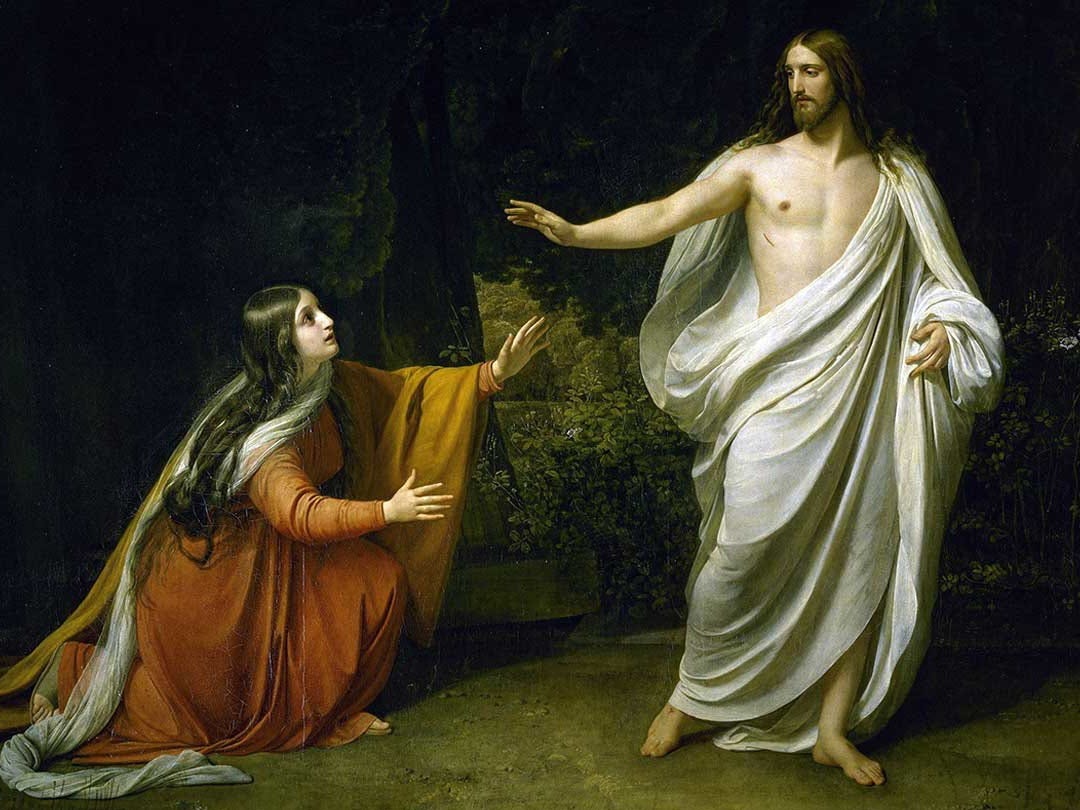
John 20:14–17 (KJV)
14 And when she had thus said, she turned herself back, and saw Jesus standing, and knew not that it was Jesus.
15 Jesus saith unto her, Woman, why weepest thou? whom seekest thou? She, supposing Him to be the gardener, saith unto Him, Sir, if Thou have borne Him hence, tell me where Thou hast laid Him, and I will take Him away.
16 Jesus saith unto her, Mary. She turned herself, and saith unto Him, Rabboni; which is to say, Master.
17 Jesus saith unto her, Touch Me not; for I am not yet ascended to My Father: but go to My brethren, and say unto them, I ascend unto My Father, and your Father; and to My God, and your God.
He rose with a body described as flesh and bones, a body that could eat fish, bear scars, and be touched by doubting disciples.12 He didn’t ascend into non-material eternity. He ascended bodily and promised to return the same way. The disciples didn’t follow Him into ethereal transcendence. They received the Spirit and went back to building the church on earth.
Every major biblical author confronted with Gnostic-leaning ideas rejected them completely. John wrote his first epistle partly to combat early Gnostic teachers who denied that Jesus came in the flesh. Paul warned against those who forbade marriage and demanded abstinence from foods, calling such teaching demonic precisely because it despised the goodness of created matter.
The Greek philosophical vision: escape the body, transcend matter, dissolve into the eternal.
The biblical vision: resurrection, restoration, reign.
These are not two ways of saying the same thing. They are incompatible operating systems producing opposite civilizational outcomes.
Correcting the Programming Error
If you’ve been taught that earth is temporary and heaven is elsewhere, you’ve been running compromised theological code. The correction isn’t complicated, but it requires confronting how deeply the inversion has shaped your assumptions about what it means to be a Christian.
We’re not leaving. We’re inheriting.
You’re not waiting for evacuation from a doomed planet. You’re preparing for dominion over a restored one. The kingdom doesn’t arrive when Christians escape earth. It arrives when heaven invades earth and God makes all things new. Your body isn’t a prison you’re counting down the days to escape. It’s the temple of the Holy Spirit, designed for resurrection and eternal physical existence.
Your work isn’t a distraction from spiritual priorities. It’s training for the rulership you were created to exercise. Your city isn’t disposable scenery in a cosmic drama that ends with everything burning. It’s territory you’re commissioned to steward, knowing that what you build in faithfulness becomes part of the inheritance of renewed creation.
When you stop despising matter, you stop surrendering. When you honor creation as God’s handiwork rather than treating it as spiritual enemy territory, you start building for generations instead of just surviving until the rapture. When you expect resurrection instead of evacuation, you plant trees you’ll never sit under because you know you’ll see them again in the age to come.
This isn’t a call to earthly-mindedness that forgets heaven. It’s a call to biblical eschatology that remembers what heaven actually is: the reign of God established on a renewed earth where righteousness dwells and the knowledge of the Lord covers the earth as the waters cover the sea.
The Assignment
Here’s what changes when you reject the Gnostic infiltration and return to biblical categories.
Stop treating earth like a sinking ship you’re trying to escape. Stop building like everything you make will burn. Stop apologizing for caring about cities, culture, work, and bodies. Stop acting like physical health is vanity, like beauty is suspect, like generational thinking is worldly attachment.
You were designed for physical resurrection on a restored earth. Act like it.
Honor your body as the instrument through which you serve God and will serve Him forever in resurrected form. Build for your grandchildren and their grandchildren, knowing that faithfulness compounds across generations. Invest in your city with the understanding that you’re stewarding territory that matters eternally. Create culture, music, art, literature, technology, that reflects the kingdom, because culture-making is part of the dominion mandate, not a distraction from it.
Treat your work as training for eternal reign, because that’s precisely what it is. God isn’t going to hand you rulership over cities in the age to come if you refused to take responsibility for anything in this one. The parable of the talents isn’t about spiritual gifts. It’s about faithfulness with actual resources producing actual multiplication that results in actual governmental authority.
Babylon wants you checking out. Dispensationalism offered the permission structure for that retreat, packaging it as higher spirituality while entire civilizations slipped through Christian hands.13 Gnosticism provides the philosophical framework. Matter doesn’t matter. Earth is disposable. Bodies are prisons. Just wait for the escape pod.
Biblical eschatology is the rearmament. It tells you the truth: this earth is your eternal home, given to humanity as an inheritance, lost through rebellion, purchased back through the blood of Christ, and destined for complete restoration when the kingdom comes in fullness.
You’re not escaping. You’re reclaiming.
Every inch of ground. Every sphere of culture. Every institution that shapes human flourishing. Not through worldly power plays or political compromise, but through faithful presence, generational thinking, and the slow, steady work of building what endures.
The meek inherit the earth. Not heaven as an escape from earth. The earth itself, restored and glorified, ruled by resurrected saints in partnership with the God who never intended to abandon His creation but always planned to dwell within it.
Execute accordingly.
Romans 8:19-21
“For the creation waits with eager longing for the revealing of the sons of God. … creation itself will be set free from its bondage to corruption and obtain the freedom of the glory of the children of God.”

THE GNOSTIC TRAP: Why Half Your Timeline Is Accidentally Heretical
Share this with Christians who are tired of curated comfort and hungry for unvarnished truth.
References
Gnosticism and the Demiurge: Gnostic movements in the early church (2nd-3rd centuries) taught that the material world was created not by the true God but by an inferior deity called the demiurge. Salvation, in their system, required esoteric knowledge (gnosis) to free the divine spark trapped in physical flesh. This
represented a fundamental rejection of the Genesis account where God declares physical creation “very good” (Genesis 1:31). The early church fathers, particularly Irenaeus in Against Heresies, fought extensively against these teachings, recognizing them as incompatible with biblical faith.
Platonic Dualism: Plato’s philosophy (4th century BC) established a hierarchical dualism where eternal, immaterial Forms were superior to the changing, material world. In dialogues like Phaedo, he described the body as a prison (soma/sema) from which the soul seeks liberation. This matter-despising framework predated Christianity by centuries but became a persistent influence as educated converts brought Greek philosophical categories into theological discourse. The challenge was distinguishing legitimate use of philosophical language from absorption of anti-biblical premises about creation’s goodness.
Early Christian Responses to Gnostic Ideas: Some early believers, encountering Gnostic thought, developed extreme ascetic practices, severe fasting, celibacy mandates, self-flagellation, treating the body as an enemy to be conquered. Others embraced libertinism, reasoning that if matter was irrelevant or evil, physical actions had no moral consequence. Both extremes stemmed from the same corrupted premise: that spirit and matter were opposed rather than integrated aspects of God’s good creation. Paul confronted both tendencies in his letters (see Colossians 2:20-23 on asceticism, 1 Corinthians 6:12-20 on libertinism)
Augustine's Neoplatonic Influence: Augustine of Hippo (354-430 AD), the most influential theologian in Western Christianity, was deeply shaped by nine years as a Manichaean (a Gnostic sect) and his later immersion in Neoplatonism before his conversion. While he rejected many Gnostic teachings, he retained a hierarchical framework where the eternal, unchanging soul was superior to the temporal, decaying body. His brilliant synthesis of Christian theology with Platonic categories embedded this dualism into Western theological DNA for over 1,500 years. Works like City of God and Confessions reveal both his genuine faith and his ongoing struggle with matter-despising tendencies.
Dispensationalism as Theological Innovation: John Nelson Darby, an Irish Anglican priest turned Plymouth Brethren leader, developed dispensationalism in the 1830s-1840s. His system divided history into distinct ages (dispensations) and taught that the church was a parenthetical, heavenly people completely separate from God’s earthly dealings with Israel. The pre-tribulation rapture doctrine, the idea that Christians would be evacuated before final judgment, was entirely new. No church father, no Reformer, no Christian before Darby had taught this escape theology. Yet through the Scofield Reference Bible (1909) and later popularizations like the Left Behind series, it became the default eschatology for millions of American evangelicals.
20th Century Popularization: Dispensationalist escape theology achieved massive distribution through C.I. Scofield’s annotated Bible (which embedded Darby’s system directly into Scripture margins), Hal Lindsey’s The Late Great Planet Earth (1970, over 35 million copies sold), and Tim LaHaye’s Left Behind novels (1995-2007, over 65 million copies). This made pre-tribulation rapture theology one of the most commercially successful religious ideas in modern history, despite its recent invention and lack of historical Christian precedent.
Darby’s Dualism and Cultural Withdrawal: Darby explicitly taught that the church’s calling was entirely heavenly and that Christians should form no part of earthly events, governments, or cultural institutions. This represented a sharp break from historic Christian teaching about creation stewardship, cultural mandate, and the believers’ role as salt and light. The practical result was generations of Christians trained to view political engagement as worldly compromise, cultural production as distraction, and multi-generational institution-building as pointless since Jesus would return any day.
Revelation 21-22 and the New Jerusalem: The climactic vision of Revelation describes not the destruction of earth but its renewal. The New Jerusalem, described with concrete physical details (foundations of precious stones, streets of gold, a river, the tree of life), descends from heaven to earth—heaven and earth reunited. God establishes His dwelling place with humanity in physical space. Nations bring their glory and honor into the city. Kings of the earth walk through gates that never close. This is not evacuation theology but restoration vision: the material world redeemed, not abandoned.
Creation Bookends: The Bible’s narrative arc moves from garden (Eden, Genesis 1-2) to garden city (New Jerusalem, Revelation 21-22). God creates humans in a garden with the mandate to fill, subdue, and steward creation. After the fall, redemption, and final judgment, the story concludes not with disembodied souls in ethereal heaven but with God dwelling with humanity in a restored creation that combines the intimacy of Eden with the cultural development of a city. The trajectory is not escape from matter but the redemption and glorification of physical creation.
Isaiah’s New Creation Vision: Isaiah 65:17-25 describes new heavens and a new earth where people build houses and inhabit them, plant vineyards and eat their fruit, with no one taking their labor. Children are born, people age to fullness, and physical work continues. This vision directly contradicts escape theology—it’s not about souls floating in clouds but about embodied human life in a restored creation where the curse of Genesis 3 is finally lifted and creation operates as originally intended.
Paul’s Resurrection Theology: In 1 Corinthians 15:35-49, Paul uses agricultural metaphor to explain resurrection. A seed must die to produce a plant, but what emerges is more glorious than what was planted—not less material but transformed. The resurrection body is “imperishable,” “glorious,” “powerful,” and “spiritual” (meaning Spirit-empowered, not non-physical). Paul explicitly contrasts this with Greek immortality-of-the-soul concepts, insisting on bodily resurrection. He’s not hoping to escape his body but to receive its glorified, eternal form.
Jesus’s Physical Resurrection: After rising from death, Jesus explicitly demonstrated His physical resurrection to counter any Gnostic-leaning interpretations. In Luke 24:39-43, He tells fearful disciples, “A ghost does not have flesh and bones, as you see I have,” then eats fish to prove His materiality. In John 20:27, He invites Thomas to touch His crucifixion wounds. In Acts 1:9-11, He ascends bodily and angels promise He will return “in the same way.” Jesus’s resurrection body is the pattern for ours (Philippians 3:21)—transformed, glorified, imperishable, but undeniably physical.
Commercial Success of Escape Theology: Dispensationalist rapture theology became a publishing phenomenon precisely because it offered psychological relief from the burden of civilizational responsibility. If Jesus is returning soon to evacuate believers, you don’t need to build universities that last centuries, plant churches that disciple nations, or create culture for your great-grandchildren. You can focus on personal piety and soul-winning while yielding every other sphere of influence. This message found massive market appeal in 20th century America, but its popularity doesn’t make it biblical.
Stumbled upon your article I am still a relatively new believer and learning and sorting through a lot of theological perspectives still. Is this linked with dominion theology and the 7 mountain mandate which from what I’ve read gets a pretty bad wrap and doesn’t produce very good fruit or your speaking to something different?
It's my opinion that this idea of Christians being evacuated from earth, is part of the reason why you have a country like Nigeria that is basically half christian and half muslim, yet the muslim population pretty much runs their government.
As a consequence of this (christian) attitude, the government, which is predominantly comprised of muslims has turned a blind eye to the christian genocide that has been taking place there.