
He Translated Your Bible. They Burned Him for It.
October 6, 1536. Vilvoorde Castle, outside Brussels.
The man they brought out at dawn could read eight languages. They wrapped iron around his neck, tied him to the post, and strangled him before the city woke up. Then they lit the fire. The charge was heresy. The crime was a Bible in plain English.
His last recorded words were a prayer.
“Lord, open the King of England’s eyes.”
Three years later, Henry VIII authorized an English Bible for every parish church in England.
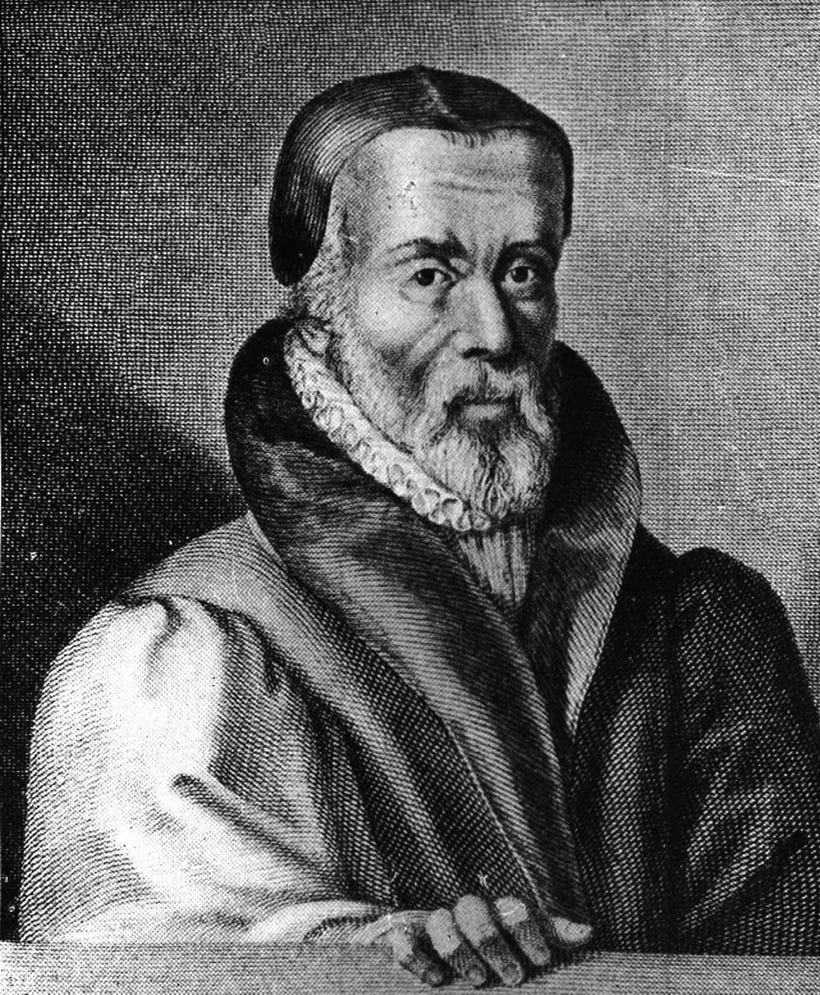
His name was William Tyndale. And if you have ever read an English Bible — any English Bible, from any shelf, in any tradition — you have read his translation.
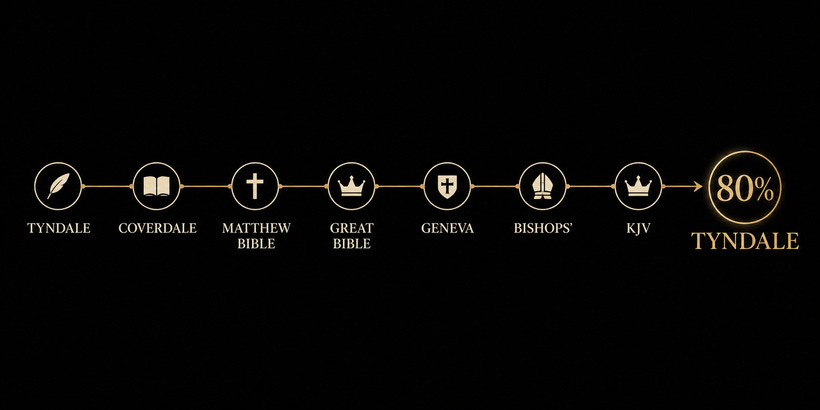
The King James Version, that monument of English prose that still sits on nightstands and church pews across the Western world, is approximately eighty percent his translation. The committees of 1611 refined his register. Smoothed his edges. Elevated the formality. But the bones are his.
The man they burned built the house you read in.
The origin of the whole collision was a single conversation. A clergyman, credentialed, learned by the standards of his institution, comfortable inside the structure, told Tyndale that common people were better off without the Scripture than without the Pope’s laws. That the text required management. That the gap between what the institution taught and what the book said was a feature, not a defect, and the people were not equipped to close it themselves.
Tyndale’s answer has not aged a day:
“I defy the Pope and all his laws. If God spare my life, ere many years I will cause a boy that driveth the plough shall know more of the scripture than thou dost.”
Read that slowly.
He is not saying the clergy is wrong about a fine point of theology. He is saying the gap between what the institution teaches and what the text actually contains is large enough that a plowboy with a Bible will immediately notice it.
He was right. Which is precisely why they had to stop the plowboy from getting the Bible.
This is not new ground. Jeremiah walked it first:
“How will you say, We are wise, and the law of the Lord is with us? In vain have the scribes used a false pen.” - Jeremiah 8:8 (EOB)
The scribes had the scroll. The scribes had the credentials. The scribes had the institutional authority, the robes, the Latin, the buildings, the centuries of unbroken succession.
And the scribes were lying.
This is the thing about institutions that have grown comfortable: they stop asking whether they are telling the truth and start asking whether they are maintaining order. These are not the same question. They are not even close.
Tyndale could not do this work in England. The church and the crown would not allow it. He fled to the continent in 1524 and never came back. He worked in exile, in hiding, in borrowed rooms, always moving. Cologne. Worms. Antwerp. The New Testament came first, printed in 1526, smuggled into England in bales of cloth and sacks of grain. The authorities burned the copies they caught. They burned them publicly. They wanted the spectacle of the burning to work as a warning.
It did not work.
The Bishop of London, Cuthbert Tunstall, devised what he believed was a more sophisticated plan. He would purchase every copy of Tyndale’s New Testament available on the market, acquire the entire stock, clean out the supply chain, and burn them all at once. Problem solved. Threat neutralized.
He paid for the books. The money went to Tyndale. Tyndale used it to fund a revised, corrected, improved edition.
The Bishop of London personally financed the expansion of the project he was trying to destroy. It is the special gift of God to men who mistake money for power and power for truth.
The translation itself was not neutral work. It never is. Every translator makes choices, and Tyndale’s choices were arguments. He rendered the Greek ekklesia as “congregation” rather than “church.” He rendered presbyteros as “elder” rather than “priest.” He rendered metanoia as “repentance” rather than “penance.” Each of these choices collapsed a piece of the institutional scaffolding. Penance required a priest. A priest required a hierarchy. A hierarchy required Rome. Pull one brick and you feel the whole wall shift.
This is why the King James committees of 1611 quietly walked several of his choices back. “Congregation” became “church” again. The Church of England had replaced Rome as the reigning institution. It needed the word “church” in the text. The Greek was irrelevant.
The translation served the throne. It always does, when the throne is paying for it.
Tyndale’s translation had no throne behind it. Only a conviction that the text meant what it said, and that ordinary people deserved to read it in their own language, and that if the institution collapsed under that reading then perhaps the institution deserved to collapse.
The end came through betrayal. A man named Henry Phillips, running from his own debts, came into Tyndale’s circle in Antwerp. He presented himself as a friend. A fellow traveler. A sympathetic ear. Tyndale trusted him. Walked into a street ambush with him. Was arrested, taken to Vilvoorde Castle, and held for over a year while the formal charge of heresy was assembled and confirmed.
He spent that year in a cold cell.
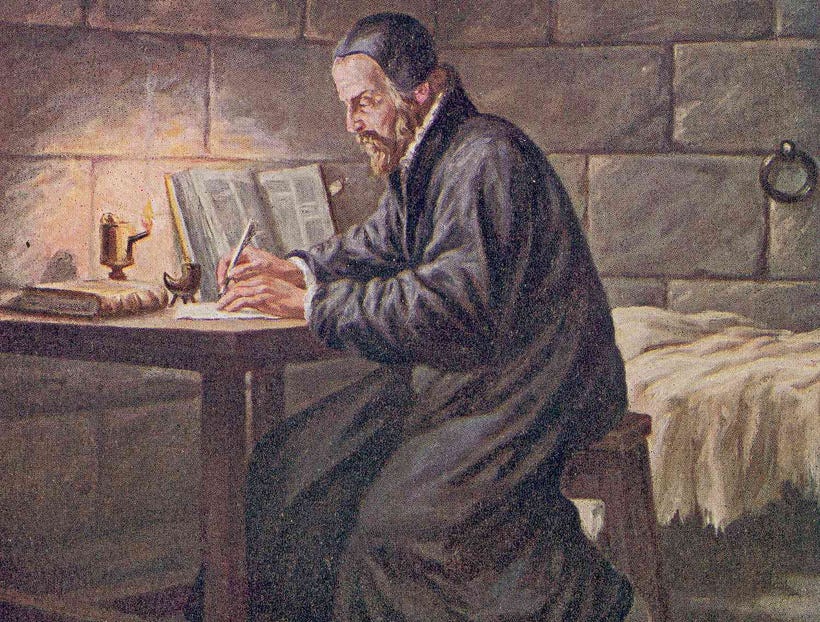
He wanted to keep working.
They strangled him in the morning. Burned what remained. Thought that was the end of it.
Within four years of Tyndale’s death, English Bibles were chained to the lecterns of English churches by royal decree. The institution that burned him for translating the Bible into English was now mandating that every Englishman have access to an English Bible. Within a century his translation became the backbone of the most widely printed book in human history. Every English Bible that followed was built on his foundation.
They strangled him at dawn and handed him to every generation that came after. They thought fire was a conclusion. It was a distribution method.
There is a question underneath all of this that has nothing to do with the sixteenth century.
Who told you what the text says? Who translated the frame through which you read the history? Who decided which books were trustworthy and which were excess, which councils were authoritative and which were fringe, which scholarship was credentialed and which was suspect?
The institution always has an answer. The answer is always itself.
Consensus inside a closed system is not evidence, it is weather.
Tyndale did not check the institution’s permission before he checked the text.
He checked the text. Then the institution came for him.
That is still the order of operations. Nothing has changed. The names on the buildings change. The robes change. The language of the gatekeeping changes. The structure does not.
“Whether it is right in the sight of God to listen to you rather than to God, you judge.” - Acts 4:19 (BLB)
Peter said that to a council that had all the authority, all the tradition, all the credentials, and all the numbers.
He said it on his way out the door.
Tyndale understood this. That is why he could work in exile. That is why he could sleep in borrowed rooms with soldiers at the border. That is why he could write warmer clothes and a Hebrew Bible in a letter from a cold cell.
The plowboy got the Bible.
It just cost Tyndale everything to deliver it.
More at [kingdomcodearchive.com]. Support the work on [Patreon].
Sadly so many translations do miss the core of scripture because people have learned of “ dictionary” meanings rather than actual text. Hebrew root words which is mainly OT had multiple meanings based on the structure of content, Greek which is a lot of NT translations took away original meanings also! This is a beautiful article. Thank you so much for sharing!
I just mentioned Tyndale to our Wednesday night Bible study last week! I’m glad to see his story getting coverage here on Substack. All for a desire to print Scripture in a language that common people could actually read.