
How Do "Experts" Actually Date Ancient Manuscripts?
The evidence behind manuscript dates, authorship claims, and the conclusions we are told to trust.
If you read enough biblical teaching, manuscript discussion, or church-history debate, you will eventually meet the final authority of the modern age:
“Experts say.”
The phrase is frequently delivered as though the matter has been settled, the courtroom has emptied, and no ordinary reader is permitted to inspect the evidence.
Experts say the manuscript is late.
Experts say the author could not have written it.
Experts say the text was edited centuries afterward.
Experts say the attribution is legendary.
End of discussion.
Certainly, expert work is appreciated here at Kingdom Code. Most of us do not have access to manuscript vaults, specialist laboratories, forgotten languages, or decades of training in ancient handwriting. Scholars, conservators, archivists, chemists, translators, and historians preserve and investigate materials the rest of us would never be able to examine alone.
That work deserves respect.
But one principle must remain clear, dear reader:
An expert conclusion is still a human conclusion.
It is an interpretation of the evidence currently available. It depends upon particular methods, comparisons, assumptions, and degrees of probability. It can be strong. It can be weak. It can be revised when new evidence enters the room.
It is not the Word of God.
Here at Kingdom Code, we are not satisfied with:
“Experts say, therefore the matter is closed.”
We want to know what evidence they examined. We want to know which method they used, what that method can actually establish, and where human judgment entered the process.
So when someone tells you that a manuscript dates to the fourth century, what exactly do they mean?
Did the scribe sign and date the final page?
Was the parchment tested in a laboratory?
Was the handwriting compared with another manuscript?
And how can anyone determine when a work was originally composed if its earliest surviving copy was made centuries later?
Let us examine the case.
One Word, Three Different Questions
The first difficulty is that people use the word “manuscript” to refer to several different things.
When someone says, “This manuscript dates to the fourth century,” they may be making one of three claims.
The first concerns the surviving physical object.
When was this particular piece of parchment, papyrus, or paper written on?
The second concerns the text preserved inside it.
When was the work originally composed, dictated, assembled, or edited?
The third concerns authorship.
Who actually wrote it?
These questions are related, but they are not the same.
Imagine that a manuscript copied in AD 1200 contains a work first composed around 200 BC. The physical manuscript is medieval. The text it preserves may be ancient.
Now imagine that the work claims to record the words of a figure who lived even earlier. That creates a third question. Is the named figure the original author, the traditional source, the narrative voice, or a later attribution?
One manuscript may therefore carry three very different dates:
the lifetime of the alleged author
the composition of the work
the production of the surviving copy
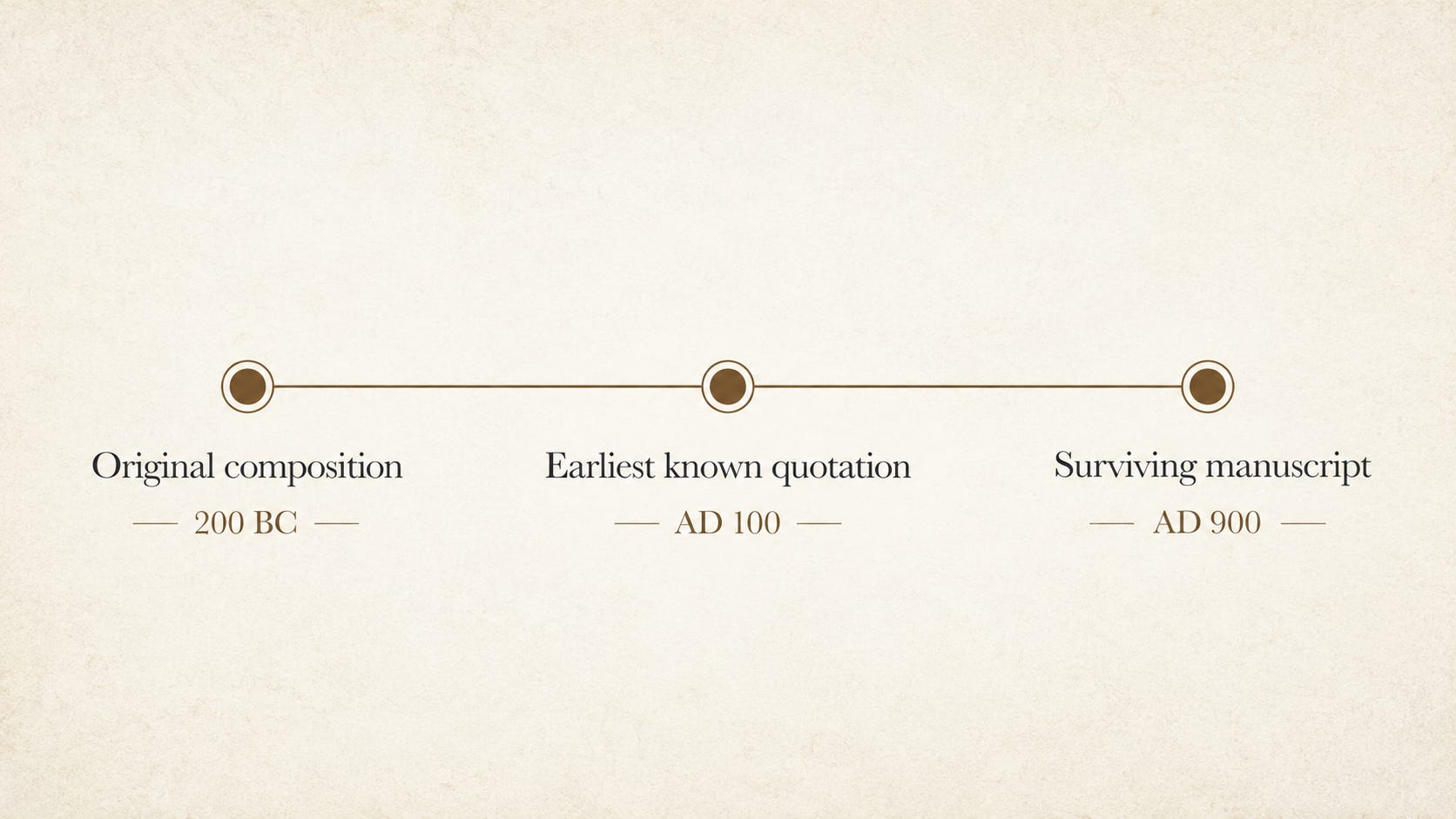
The earliest surviving copy is not automatically the original work, and a late manuscript does not automatically prove a late composition.
Confusing those dates creates much of the nonsense surrounding ancient books.
Carbon dating may tell us something about the animal skin.
It cannot tell us who composed the words written across it.
That distinction should stay in your pocket for the rest of this essay.
When the Manuscript Dates Itself
Sometimes the evidence is unusually direct.
A scribe may leave a note at the end of the manuscript naming himself, the place where he worked, the patron who commissioned the copy, and the year in which it was completed.
This closing note is called a colophon.
A colophon might read something like:
I, Matthew the scribe, completed this book in the monastery of Saint George during the reign of King Michael, in the year 6842 from creation.
That would be valuable evidence. If the calendar can be identified and the historical ruler confirmed, the manuscript may be dated with considerable confidence.
But even this is not automatically beyond question.
The colophon might have been copied from an earlier manuscript along with the text. Another scribe may have added it later. The book may contain several sections produced at different times. The ink and handwriting of the colophon may not match the main body.
A direct date is strong evidence.
It still has to survive examination.
Manuscripts may also contain dated ownership notes, library records, donation statements, royal seals, purchase records, or inscriptions mentioning identifiable people and events.
If a bishop wrote his name inside the book in AD 950, the manuscript must already have existed by then.
That does not tell us exactly when it was made. It creates a boundary.
The book cannot be later than the dated inscription unless the inscription itself is false.
Historical dating works like this quite often. The investigator does not begin with one perfect answer. He begins by fencing off what is possible.
Palaeography: Reading the Shape of Time
One of the most common methods used to date manuscripts is palaeography, the study of ancient handwriting.
Handwriting changes across generations.
Letters are formed differently. Certain strokes become longer or shorter. Abbreviations become fashionable. Punctuation changes. Scribes join letters in distinctive ways. Some scripts are formal and deliberate. Others are fast, compressed, and practical.
Anyone who has seen a letter written in the nineteenth century already understands the basic principle. The handwriting looks like it belongs to another age.
A palaeographer studies those changes systematically.
The expert may examine:
the shape of individual letters
the direction and angle of the pen strokes
spacing between letters and words
the use of abbreviations
punctuation
decorative flourishes
whether letters are written separately or joined
the apparent speed and discipline of the scribe
similarities with known regional traditions
The undated manuscript is then compared with manuscripts whose dates are more secure.
Suppose several dated manuscripts produced between AD 850 and 925 share a cluster of features. An undated manuscript displays the same letter forms, abbreviations, and scribal habits.
The specialist may reasonably conclude that it was probably copied during or near that period.
Notice the language.
Probably.
During or near.
Palaeography is disciplined comparison. It is not a divine timestamp.
Handwriting styles do not change everywhere on New Year’s morning. Old and new forms overlap. A scribe may preserve the style in which he was trained. A monastery may continue using conservative forms after other regions have changed. A skilled copyist may deliberately imitate an older script.
The surviving examples used for comparison may also be incomplete.
This is why palaeographic dates are usually given as ranges:
Late fourth century.
Fifth or early sixth century.
Approximately AD 875 to 925.
When you see a manuscript assigned to the exact year AD 417 without a colophon or other direct evidence, ask what produced that precision.
A broad method should not be allowed to wear an exact costume.
Codicology: The Book as an Archaeological Site
Palaeography studies the handwriting.
Codicology studies the book itself.
It asks how the object was manufactured, assembled, repaired, and used.
Experts examine:
whether the writing surface is parchment, papyrus, or paper
the size and shape of the pages
how sheets were folded
how pages were gathered into sections called quires
how the quires were sewn together
how lines and margins were ruled
whether pages were replaced
whether several scribes worked on the book
whether the current binding is original
whether corrections and additions were made later
Bookmaking techniques vary across regions and periods.
A certain pattern of folding may be typical of one tradition. A particular style of ruling may appear in one century and disappear in another. The way parchment was prepared, pierced, folded, and sewn can help locate the manuscript inside a historical world.
Codicology may also reveal that what appears to be one manuscript is really several objects joined together.
One section may have been copied in the ninth century.
Another may have been added in the eleventh.
The entire volume may have been rebound in the fifteenth.
A damaged leaf may have been replaced in the eighteenth.
The manuscript is therefore not always one object from one moment.
Sometimes it is a small archaeological site held together by thread.
This matters because people often speak of “the date of the manuscript” as though every page shares one origin.
It may not.
The investigator has to determine which component is being dated.
Radiocarbon Dating: What the Machine Actually Measures
Radiocarbon dating is probably the method most people trust instinctively.
A laboratory is involved. Numbers appear. There are charts, measurements, and scientific equipment.
Surely this method gives us the answer.
It can give powerful evidence.
But it is also one of the most frequently overstated methods in manuscript discussions.
Radiocarbon dating measures the remaining carbon-14 in organic material.
Parchment was made from animal skin.
Papyrus was made from a plant.
Paper was made from organic fibres.
When the animal or plant was alive, it exchanged carbon with the environment. When it died, that exchange stopped. Carbon-14 then began to decay at a measurable rate.
By measuring how much remains, researchers can estimate when the organism died.
That last sentence matters.
Radiocarbon dating does not directly measure when the words were written.
For parchment, it roughly dates when the animal died.
For papyrus, it dates the plant material.
The animal skin may have been stored before being prepared. A scribe may have reused old parchment. A manuscript might contain replacement pages produced from different material. A sample could accidentally come from a later repair.
Radiocarbon results also do not normally produce a single year.
They produce probability ranges.
A report might say that the material has a 95 percent probability of dating between AD 320 and 430.
That is valuable.
It is not the same as saying:
This manuscript was written in AD 375.
The date must be calibrated because the amount of carbon-14 in the atmosphere has not remained perfectly constant. Some periods produce wide ranges. Others may produce more than one possible range.
Contamination can also affect results. Oils, glue, smoke, preservatives, repairs, handling, or environmental exposure may introduce newer or older carbon.
Testing usually requires removing a small sample, so institutions are understandably cautious about repeatedly cutting pieces from rare manuscripts.
Radiocarbon dating is therefore strong physical evidence, especially when it agrees with palaeography and codicology.
But it dates material.
It does not date meaning.
It cannot tell you when the original work was composed, who authored it, whether the text is true, or whether the surviving copy faithfully preserves an earlier form.
The machine speaks about carbon.
Everything beyond that requires interpretation.
Ink, Pigments, and Hidden Writing
The writing material itself can also be examined.
Researchers use methods such as infrared photography, ultraviolet light, multispectral imaging, X-ray fluorescence, Raman spectroscopy, and microscopic analysis.
These methods can reveal details invisible to the naked eye.
A faded passage may become readable under a different wavelength of light.
Erased writing may appear beneath a later text.
Different inks may show that corrections were made at another stage.
Pigments may contain substances inconsistent with the claimed period.
A manuscript that was scraped clean and reused is called a palimpsest. Modern imaging has allowed researchers to recover texts that scribes attempted to erase centuries ago.
Material analysis is also useful for detecting forgery.
If a supposedly ancient manuscript contains a pigment developed in the nineteenth century, the claim has a serious problem.
But the reverse does not automatically follow.
Historically plausible ink does not prove that a manuscript is ancient. A capable forger might use old parchment or reproduce an ancient ink recipe.
Different ink does not necessarily mean a different century either. The original scribe may simply have prepared a new batch. Another worker may have added headings while the manuscript was still being produced.
Scientific analysis identifies differences.
Human judgment still has to explain them.
Provenance: Where Has This Object Been?
Provenance is the documented history of an object.
Where was it discovered?
Who owned it?
When did it enter a monastery, library, museum, private collection, or market?
Does it appear in earlier catalogues?
Was it excavated under controlled conditions?
Can the chain of ownership be independently verified?
A manuscript recovered during a documented archaeological excavation enters the discussion with context. Researchers know where it was found, what surrounded it, how it was handled, and who recorded the discovery.
A manuscript that suddenly appears in the hands of an anonymous dealer is more difficult.
It may still be genuine.
But it enters the courtroom without witnesses.
Poor provenance increases the risk of forgery, theft, contamination, and invented history. It also destroys archaeological information. Even an authentic manuscript loses part of its story when removed from its original setting without documentation.
Warning signs include:
vague claims about a cave or monastery
unnamed former owners
contradictory discovery stories
missing export documents
sudden appearance after a famous discovery
refusal to permit independent testing
a suspiciously perfect match with modern expectations
Weak provenance does not prove fraud.
It weakens confidence.
That distinction matters. Serious investigation does not turn suspicion into certainty merely because suspicion is exciting.
Dating the Text When the Original Is Gone
Everything we have discussed so far concerns the physical manuscript.
But what if the surviving copy is not the original?
That is normal.
Most ancient works survive through copies of copies. The original sheet written by the author has vanished. Scholars therefore have to estimate when the work itself was composed.
This is more difficult because no laboratory can carbon-date a lost original.
The case has to be built from historical clues.
One powerful clue is the earliest known quotation.
Suppose an author writing in AD 150 quotes a passage from another work.
The quoted work must have existed by AD 150.
This creates what historians call a terminus ante quem, the latest boundary before which something must have existed.
The work may be much earlier.
But it cannot have been composed after AD 150 unless the quotation has been misidentified or added later.
The opposite boundary is called a terminus post quem.
Suppose the work clearly refers to an event that occurred in 167 BC. It likely reached that form after the event.
The investigator may therefore conclude:
The work was composed after 167 BC but before AD 150.
That is still a wide range, but the field has been narrowed.
Experts also examine the historical world assumed by the text.
Does it mention a standing temple?
A destroyed city?
A particular ruler?
A political office?
A form of taxation?
A church hierarchy?
A legal practice?
A war?
A persecution?
The text may contain knowledge that places it after one event and before another.
This evidence is strongest when the reference is specific and difficult to explain otherwise.
It becomes weaker when the argument depends on silence.
A text’s failure to mention an event does not prove the event had not happened. The author may not have cared about it. The section may not have required it. The work may be incomplete.
Silence can matter.
It must not be forced to testify beyond what it knows.
Language as a Historical Witness
Language changes over time.
Words appear and disappear. Grammar shifts. Spellings change. Foreign terms enter a language through trade, conquest, administration, and migration.
Experts therefore study:
vocabulary
grammar
syntax
spelling
loanwords
idioms
titles
naming conventions
recurring phrases
A Hebrew text may resemble Biblical Hebrew, Late Biblical Hebrew, Qumran Hebrew, rabbinic Hebrew, or a later learned imitation.
A Greek work may display features associated with the Hellenistic or Roman period.
This can provide important evidence.
But language is not a prison.
Writers can imitate older forms. Religious communities may preserve archaic vocabulary. A copyist may modernize spelling. A translator may reshape the language of the original. Different sections may have been produced at different times.
Language can indicate a historical setting.
It rarely proves a date by itself.
The responsible conclusion usually sounds like:
The language is consistent with this period.
Not:
This single word proves the work was written in this exact decade.
Which Text Knew Which?
Experts also compare works to determine whether one appears to depend on another.
If Text B reproduces unusual wording from Text A, follows the same sequence, and expands upon A’s ideas, B may be later.
That sounds simple until several possibilities enter the room.
Perhaps both works used a lost source.
Perhaps both drew from oral tradition.
Perhaps the wording came from a common liturgy.
Perhaps both were quoting Scripture.
Perhaps a later copyist harmonized one text with the other.
Literary dependence can be persuasive when the parallels are extensive, distinctive, and ordered.
It becomes weaker when built upon one general idea or common phrase.
“Love your neighbour” does not prove that every ancient writer who used the idea copied one specific document.
The more unusual the shared material, the stronger the case for relationship.
But relationship is not always direct dependence.
The family tree of ancient texts has many missing branches.
Who Actually Wrote It?
Authorship is often the most uncertain part of the entire discussion.
Many ancient works are anonymous.
The author’s name may appear only in a later manuscript title, a church catalogue, a scribal heading, or the testimony of another writer.
Those forms of attribution do not carry equal weight.
Experts ask several questions:
Does the text name its author?
Is that name part of the earliest recoverable form?
How early do outside witnesses connect the work with that person?
Do independent sources agree?
Does the author display knowledge the named figure should possess?
Does the vocabulary resemble securely attributed works?
Does the theology fit?
Could differences be explained by genre, age, subject matter, a secretary, translator, editor, or later compiler?
A work saying “I, Enoch,” “I, Ezra,” or “Paul” is evidence.
It is not final proof.
Ancient writers sometimes placed teachings in the voice of a revered figure. Scholars frequently describe such works as pseudepigraphal, meaning written under another person’s name.
But that category should not become a shortcut.
Calling a work pseudepigraphal is itself a conclusion. The evidence still has to be shown.
Sometimes scholars reason like this:
The named author could not have written the text because the text is late.
Then they date the text late because they believe the named author did not write it.
That is circular if no independent evidence breaks the loop.
At other times, the case is much stronger. The work may mention events centuries after the named person’s death, use institutions that did not yet exist, or appear only in much later testimony.
Authorship claims exist on a ladder.
At the top is a securely contemporary attribution supported by early evidence.
Below that is a strong and consistent ancient tradition.
Then comes a plausible but disputed attribution.
Then an anonymous work later attached to a famous name.
Readers should be told where the conclusion stands.
“Written by Moses” and “traditionally attributed to Moses” are not the same statement.
“Paul wrote this” and “the earliest surviving manuscripts include Paul’s name” are not identical claims either.
The language should match the evidence.
Can Computers Identify an Author?
Modern stylometry attempts to identify patterns in writing style.
A computer may count:
word frequency
average sentence length
use of conjunctions
preferred vocabulary
recurring grammatical habits
function words such as “and,” “but,” or “therefore”
The theory is that writers develop habits they do not consciously control.
This can be useful, especially when comparing large amounts of material written in the same language and genre.
But ancient texts create complications.
A short letter may provide too little data.
A sermon and a private letter by the same person may sound different.
A translator can bury the style of the original author.
A secretary may shape the final language.
Later editors may alter the work.
The subject itself affects vocabulary. A person writing about resurrection will naturally use different words than when discussing travel arrangements.
Stylometry can identify patterns.
It cannot scan a text and print the author’s name like a fingerprint machine.
Textual Criticism: Reconstructing a Work from Copies
Once a work has been copied repeatedly, the surviving manuscripts will differ.
Before printing, every copy was produced by a human hand.
Scribes skipped lines.
They repeated phrases.
They confused similar letters.
They replaced unfamiliar words with familiar ones.
They corrected grammar.
They harmonized parallel passages.
They wrote explanations in the margin.
A later copyist sometimes copied the explanation into the main text.
Most differences are ordinary and easy to recognize.
Some are more difficult.
Textual critics compare manuscripts to determine which readings are earlier and how the copies are related.
Shared mistakes can be especially revealing.
Suppose three manuscripts omit the same line because two nearby sentences ended with the same words. Those manuscripts may descend from a common ancestor in which the omission first occurred.
This creates manuscript families.
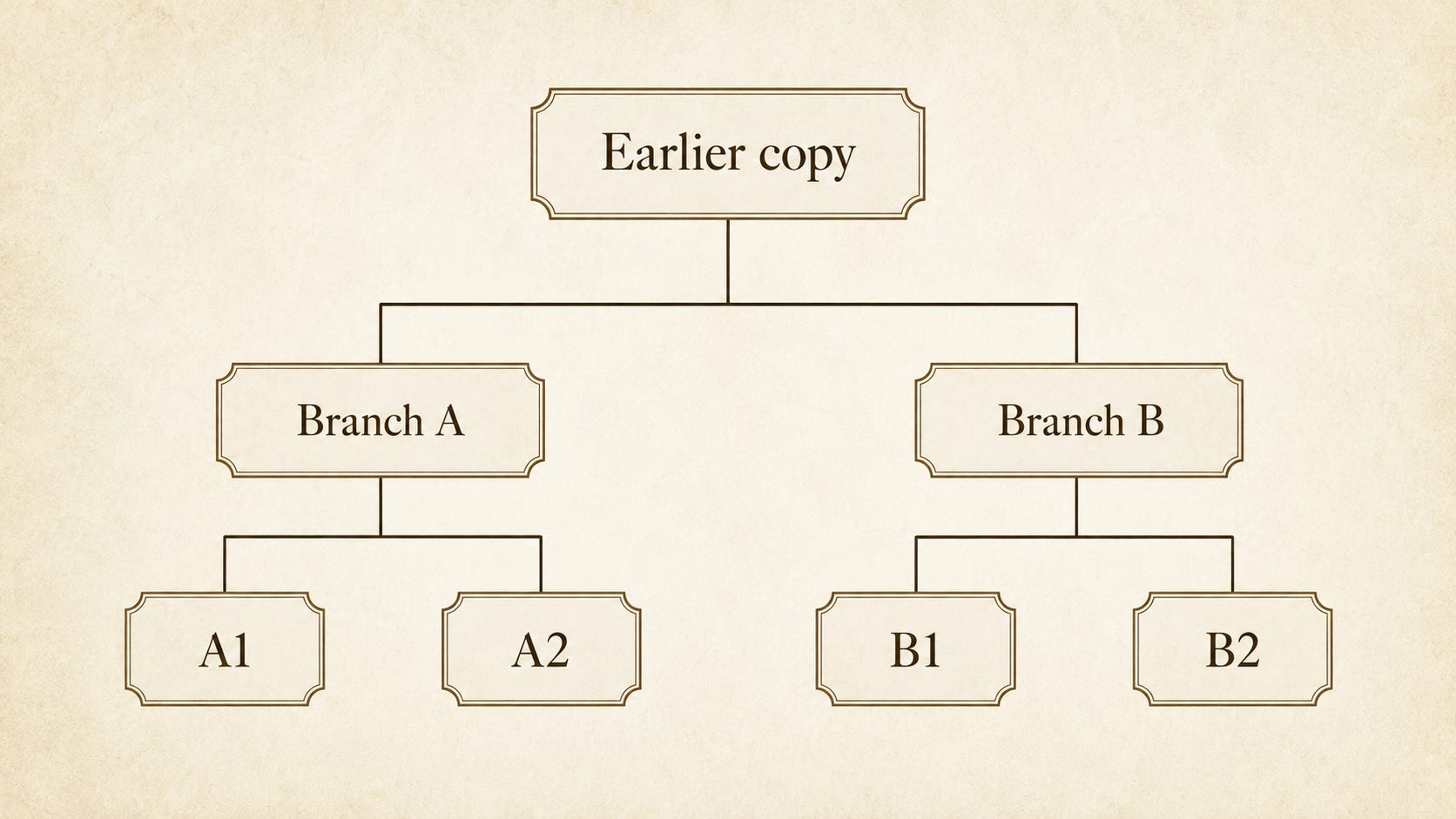
The number of surviving copies must therefore be handled carefully.
A thousand manuscripts descended from one late ancestor are not a thousand independent witnesses.
They are a large family repeating the testimony of one branch.
Age also matters, but the oldest surviving copy does not automatically preserve the oldest reading.
A later manuscript may descend from an ancient line that was copied carefully. An earlier manuscript may contain a local alteration.
Textual critics therefore consider both external and internal evidence.
External evidence includes:
the age of the manuscript
its geographical location
its textual family
whether witnesses are independent
the general quality of the copy
Internal evidence asks:
Which reading best explains the others?
Which form is a scribe more likely to change?
Did a difficult reading become smoother?
Was one passage harmonized with another?
Could words have been accidentally skipped?
This is historical reasoning.
It is not arbitrary, but neither is it mechanical.
Two serious experts may examine the same evidence and assign different weight to different witnesses.
That disagreement does not mean the entire discipline is useless.
It means the evidence requires judgment.
Not Every Scholarly Conclusion Has the Same Weight
One of the worst habits in popular teaching is flattening every scholarly conclusion into the same category.
Some manuscript dates are extremely secure.
Others are educated estimates.
A manuscript with a verified colophon, strong provenance, compatible handwriting, and matching material evidence has a powerful case.
A manuscript dated mainly by general handwriting comparison has a useful but less exact case.
An authorship theory built upon a late tradition and one ambiguous phrase is weaker still.
Readers need a language of confidence.
At Kingdom Code, we can think in terms like these:
Direct evidence
The manuscript contains a verified date, or a securely documented event establishes its existence.
Strong inference
Several independent lines of evidence converge on the same conclusion.
Probable
The conclusion explains the evidence better than its current alternatives, but it is not certain.
Possible
The evidence allows the conclusion but does not strongly require it.
Speculative
The claim is interesting, but the surviving evidence cannot carry much weight.
That is not cowardly language.
It is clean language.
Humility does not mean refusing to reach conclusions.
It means refusing to make the evidence carry more than it can bear.
Questions to Ask When “Experts Say”
When someone tells you a manuscript was written at a certain time, ask:
What exactly is being dated?
The physical object?
The composition of the text?
The alleged author?
Then ask which method produced the conclusion.
Was there a colophon?
Was the material radiocarbon-dated?
Was the handwriting compared palaeographically?
Was the book’s construction examined?
Is there an early quotation?
Does the argument depend upon language, historical references, or literary dependence?
Is the date presented as an exact year when the evidence only supports a century?
Is the conclusion supported by several independent methods?
Is the provenance secure?
Are serious alternatives acknowledged?
What assumptions connect the evidence to the conclusion?
What new evidence could change it?
These questions do not make you anti-scholar.
They make you literate.
The purpose is not to stand outside a laboratory and announce that everyone inside is corrupt.
The purpose is to understand what the laboratory actually tested.
A Simple Example
Imagine that researchers discover a parchment manuscript called The Testament of Eliab.
The handwriting resembles manuscripts copied between AD 850 and 925.
Radiocarbon testing places the parchment between AD 780 and 970.
The binding appears to have been added around AD 1300.
A colophon says that a scribe named Michael completed the copy in AD 892.
Another document written around AD 600 quotes a passage from The Testament of Eliab.
The work itself claims to preserve the words of Eliab, a figure who lived in 200 BC.
What may be concluded?
The surviving manuscript was probably copied around AD 892.
The parchment date agrees with the colophon.
The binding was added later.
The text itself existed by AD 600 because another writer quoted it.
It may be earlier than AD 600.
The claim that Eliab himself wrote it remains a separate question. The first-person voice alone does not prove authorship.
Notice how much clearer the case becomes when every claim is placed in its proper field.
The parchment is not the text.
The text is not the author.
And the authorial claim is not automatically a historical fact.
Where Experts Go Wrong
Experts are human.
They can overstate conclusions.
They can inherit assumptions from their teachers.
They can follow disciplinary fashions.
They can cite one another until an unproven claim begins to look established.
They can mistake absence of evidence for evidence of absence.
They can allow a preferred historical theory to govern ambiguous clues.
They can treat a probable date as an exact one.
They can be deceived by forged provenance, contaminated samples, misleading restorations, or clever modern fraud.
Institutions can also become protective of established conclusions. Careers, reputations, grants, and academic schools are not imaginary forces.
But critics have their own temptations.
They may dismiss expertise because they dislike the conclusion.
They may accept carbon dating when it supports their argument and reject it when it does not.
They may prefer a confident YouTube voice to a cautious specialist.
They may interpret every uncertainty as proof that all possibilities are equal.
They may call a method corrupt without understanding how it works.
They may defend traditional authorship with the same circular logic they accuse scholars of using.
Skepticism also requires evidence.
The responsible position is neither:
The experts have spoken, so stop thinking.
Nor:
Experts are always wrong, so believe whatever feels older.
The stronger principle is:
Expertise deserves examination, not worship.
Evidence Is a Witness, Not a Throne
Without palaeographers, conservators, chemists, historians, linguists, archivists, and textual critics, most of us would know almost nothing about the ancient documents we discuss so confidently online.
Their work places evidence on the table.
We should be grateful for it.
But the evidence must remain visible.
The danger begins when the conclusion replaces the method, the method disappears behind institutional authority, and “experts say” becomes a wall built to stop further questions.
A manuscript date is usually not one fact discovered by one perfect test.
It is a case assembled from handwriting, material, construction, language, provenance, quotations, historical context, copying patterns, and probability.
Sometimes the case is strong.
Sometimes it is merely the best explanation presently available.
Wisdom lies in knowing the difference.
So the next time someone tells you that a manuscript is late, ancient, forged, anonymous, pseudepigraphal, or written by someone other than the person named, do not begin by accepting or rejecting the conclusion.
Ask how the conclusion was built.
Ask what was physically tested.
Ask what was inferred.
Ask what remains unknown.
The archive does not speak without interpreters.
But the interpreters should never be allowed to hide the archive.
Kingdom Code is entirely reader-supported.
If you value independent investigation rooted in Scripture and under the authority of Christ, help keep this work alive by joining the KC Archive.
And share this investigation with Christians who were taught the conclusion but never shown the evidence.
This is a keeper! It's rare to have all of this information in one place. Of course, getting into the actual details of each category and understanding what the "experts" actually say about any particular manuscript with their evidence is the hard part. For Greek NT manuscripts, the New Testament Virtual Manuscript Room is a great place to hang out (https://ntvmr.uni-muenster.de/home).