
Progressive Jesus vs. Biblical Jesus
Progressive Christianity sells a Jesus who looks suspiciously like a Brooklyn DSA member with a Coexist bumper sticker. Loves everyone. Judges no one. Affirms everything. Demands nothing.
And he’s built from the same 66-book Western canon that conservative evangelicals use, just highlighting different verses.
The biblical Jesus is entirely different. Watch what gets deleted.
One Validates Your Identity, One Demands Transformation
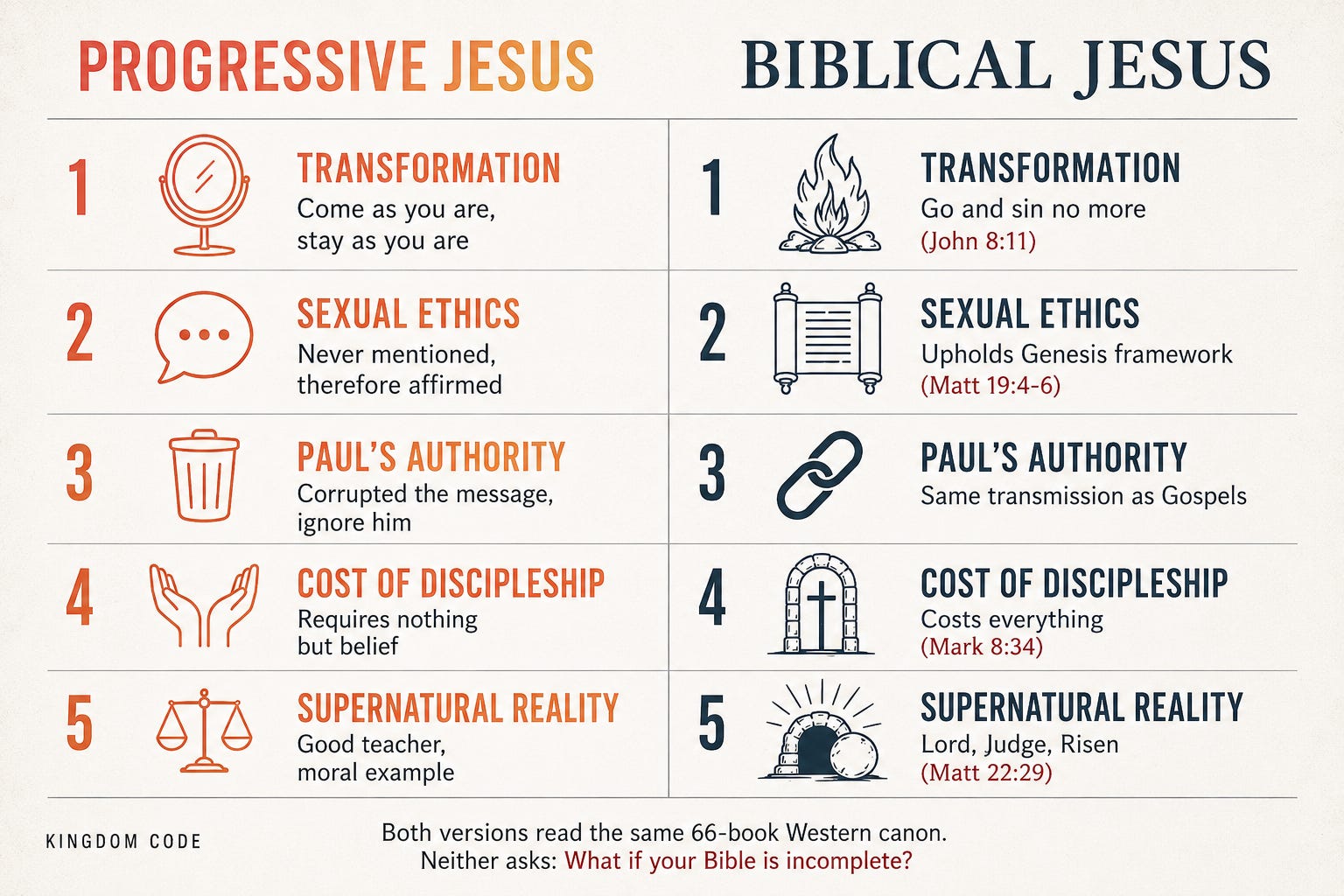
Progressive Jesus: “Come as you are, stay as you are”—your identity is sacred, unchangeable, beyond moral evaluation.
Biblical Jesus: “Go and sin no more” (John 8:11).
Religious leaders drag a woman caught in adultery to Jesus, trying to trap him. Stone her (uphold Torah) or free her (reject Torah), either way, they think they’ve got him.
Jesus doesn’t play: “Let him who is without sin cast the first stone.” They drop their rocks and leave. Progressive Christianity stops the story there. Standing ovation. Jesus the affirmer.
Except the text keeps going. After the accusers leave, Jesus tells her: “Neither do I condemn you; go, and from now on sin no more.”
Progressive Christianity deletes that second half because it doesn’t fit what they’re selling.
The biblical Jesus can hold two things at once: radical mercy and moral clarity. He defends her from legalistic violence, then tells her to stop sleeping with someone else’s husband. One doesn’t cancel the other. But progressive Jesus only does half the work, the half that requires nothing from you.
One Is Silent on Sexual Ethics, One Has Clear Boundaries
Progressive Jesus: Never mentions sexual morality, only loves people where they are.
Biblical Jesus: Affirms Genesis 1-2 marriage, lists sexual immorality (porneia) as defiling, upholds Torah’s sexual boundaries while rejecting Pharisaic additions.
Progressive claim: “Jesus never talked about homosexuality, therefore He didn’t care about it.”
Jesus never mentioned incest, bestiality, or pedophilia either. That hermeneutic does not work.
What Jesus did do: reaffirm the Genesis creation account as the marriage paradigm. Matthew 19:4-6, Pharisees ask about divorce, Jesus goes back to Eden:
“Have you not read that He who created them from the beginning made them male and female, and said, ‘Therefore a man shall leave his father and his mother and hold fast to his wife’?”
He’s pointing to the foundation already there.
Mark 7:21-23: Jesus lists what defiles a person. The list includes porneia, the Greek term for sexual acts prohibited under Torah law. First-century Jews hearing that word understood it as covering the Levitical categories: incest, prostitution, homosexual acts, violations of household boundaries. Jesus uses it without redefinition, which tells you something about what he considered self-evident.
He didn’t need to define porneia for a first-century Jewish audience. They already knew what Torah forbade. He only expanded on areas where religious leaders were getting it wrong, like manufacturing divorce loopholes (Matthew 19). The sexual boundaries weren’t up for debate. They were assumed.
Progressive Christianity claims porneia only meant temple prostitution or abusive relationships. But Paul uses the same word in 1 Corinthians 5:1 to explicitly condemn incest, a man sleeping with his father’s wife. If you trust the Gospel writers on Jesus’ use of porneia, you are trusting the same transmission stream that preserved Paul’s clarifications.
One Dismisses Paul, One Requires Paul
Progressive Jesus: Paul corrupted the simple message, added patriarchy and homophobia, ignore him.
Biblical Jesus: The same apostolic communities that preserved the Gospels also preserved Paul’s letters, you can’t accept one and reject the other.
The Gospels weren’t written by eyewitnesses sitting with notebooks during the Sermon on the Mount. They were written 40-70 years after Jesus’ death by communities preserving oral tradition and earlier written sources. Mark around 70 CE. Matthew and Luke 80-90 CE. John 90-100 CE.
Paul’s letters? Written earlier. 50-60 CE. Galatians, 1 Thessalonians, 1 Corinthians, all before the Gospels were written down.
Paul didn’t corrupt a pure Jesus movement that was already documented. Paul’s letters are the earliest Christian documents we have. The Gospels came later, written by communities that already had Paul’s letters and saw no contradiction.
If Paul had hijacked Jesus’ message, these communities wouldn’t have preserved both. They would’ve picked one. They didn’t. They saw continuity.
If you reject Paul’s authority, you’re rejecting the testimony of the same witnesses who gave you the Gospels. The early church didn’t preserve “good Jesus stuff” and “bad Paul stuff.” They preserved it all because they saw it as one continuous revelation.
One Requires Nothing, One Costs Everything
Progressive Jesus: Affirming theology, no repentance, no transformation, just “beloved community.”
Biblical Jesus: “If anyone would come after Me, let him deny himself and take up his cross and follow Me” (Mark 8:34).
The rich young ruler story (Mark 10:17-22): Man runs to Jesus, asks what he must do to inherit eternal life. Jesus lists commandments, don’t murder, don’t commit adultery, don’t steal. The man says he’s kept all these since youth.
“Jesus, looking at him, loved him, and said to him, ‘You lack one thing: go, sell all that you have and give to the poor, and you will have treasure in heaven; and come, follow Me.’”
The man walks away sad. He had great possessions.
Progressive Christianity stops at “Jesus loved him” and skips the demand. But the demand is the point. Jesus loved him and told him to give up everything. The love didn’t cancel the requirement. It intensified it.
Luke 14:26: “If anyone comes to Me and does not hate his own father and mother and wife and children and brothers and sisters, yes, and even his own life, he cannot be My disciple.”
Matthew 7:13-14: “Enter by the narrow gate. For the gate is wide and the way is easy that leads to destruction, and those who enter by it are many. For the gate is narrow and the way is hard that leads to life, and those who find it are few.”
One Is a Mascot for Your Politics, One Is Lord
Progressive Jesus: Validates your progressive positions, never challenges your moral assumptions.
Biblical Jesus: “You are wrong, because you know neither the Scriptures nor the power of God” (Matthew 22:29).
The Sadducees were first-century institutional elites. Educated. Wealthy. Ran the Temple apparatus that collaborated with Rome. And they had a theology perfectly suited to maintaining power: reject the supernatural elements that might challenge the social order.
They bring Jesus a trick question about resurrection. He tells them they’re wrong about everything.
Then he proves resurrection from Torah, affirms angels exist, affirms final judgment, affirms supernatural reality. The biblical Jesus would make a progressive Christian deeply uncomfortable.
He wasn’t a first-century progressive. He was a first-century Jew who taught Torah’s moral core, affirmed supernatural reality, promised divine judgment, and drew boundaries that make modern progressives recoil.
Progressive Christianity projects 21st-century liberal politics onto the first century and calls it “recovering the real Jesus.”
But the real Jesus declared things progressive Christianity rejects: hell (Matthew 25:46), exclusivity (John 14:6), supernatural evil (Mark 5:1-20), substitutionary sacrifice (Mark 10:45).
Progressive Christianity claims to recover what evangelicalism hid. Both are playing the same game: selective reading of the same 66-book Western canon.
Progressive Jesus is what you get when you cherry-pick a mascot from an already incomplete set. Biblical Jesus is what happens when you read the whole tradition, including the parts that challenge you.
Now, create a contrast with conservative nationalism Jesus.
Rocka, You say, "And he’s built from the same 66-book Western canon that conservative evangelicals use, just highlighting different verses." I don't think it's the Westen canon that's the problem, but the liberal mindset that twists Scripture "to their own destruction" (2 Peter 3:16). They'd do the same with the Ethiopian Bible and their 88 books. I bless you.