
The Five Questions Genesis 6 Doesn't Answer (And the Text That Does)
The Enoch Files
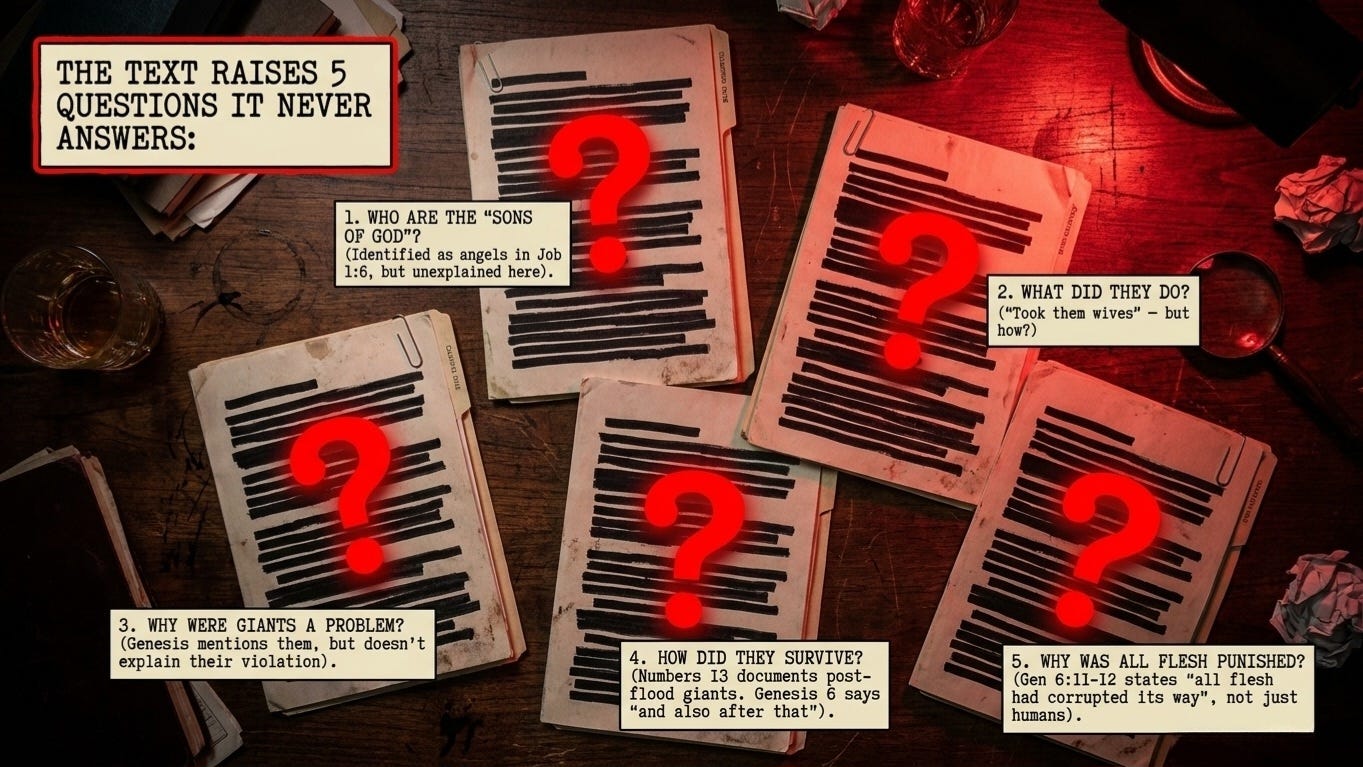
You have heard ten different explanations of Genesis 6.
The sons of God were the godly line of Seth. Or they were fallen angels. Or they were human kings. Or they were demons possessing men. Or they were extraterrestrials. Or the whole passage is metaphor for intermarriage between Cain’s line and Seth’s line. Or it is ancient mythology borrowed from pagan sources and not historical at all.
Ten explanations for four verses. And none of them fit cleanly.
Each interpretation solves one problem and creates three others. The Sethite view avoids the angel difficulty but cannot explain why intermarriage between human lines would produce giants or trigger a global flood. The angelic view fits the text but raises questions about how spiritual beings procreate. The metaphor view dissolves the entire passage into symbolism but leaves you with no explanation for why Genesis treats the Nephilim as real people in real geography who are mentioned again later in Numbers.
You have been told the Bible is clear. But Genesis 6 is not clear. It is four verses that raise more questions than they answer. And the church has been fighting about those questions for two thousand years.
There is a reason for that.
The text that answers the questions was removed. The questions are still being argued. And the argument itself became the point.
Here is the entire Nephilim account in Genesis. All of it. Four verses.
Genesis 6:1-4 (KJV):
“And it came to pass, when men began to multiply on the face of the earth, and daughters were born unto them, that the sons of God saw the daughters of men that they were fair; and they took them wives of all which they chose. And the Lord said, My spirit shall not always strive with man, for that he also is flesh: yet his days shall be an hundred and twenty years. There were giants in the earth in those days; and also after that, when the sons of God came in unto the daughters of men, and they bare children to them, the same became mighty men which were in old time, men of renown.”
Four verses. That is the complete canonical account of the Nephilim origin. Count the words. Ninety-seven in the KJV. Less than a hundred words to describe an event so catastrophic it required the destruction of all life on earth except eight people and the animals in one boat.
1: Who are the sons of God?
Genesis names them. It does not identify them.
“Sons of God” appears in four other places in the Old Testament: Job 1:6, Job 2:1, Job 38:7, and Psalm 29:1 (“angels of God” in the Septuagint). In every instance outside Genesis 6, the phrase refers to angelic beings presenting themselves before the Lord or worshiping in the heavenly assembly.
But Genesis 6 does not explain the term. It assumes you already know who they are. The identification is missing.
2: What did the sons of God actually do?
They “saw the daughters of men that they were fair” and “took them wives of all which they chose.”
But Genesis provides no detail. No description of how this occurred. No account of what the interaction looked like. No explanation of what “took them wives” entailed beyond the bare fact of union.
Later in Genesis, when marriage is described, the text includes negotiation, bride price, family involvement, ceremony. Here: nothing. Just the fact of the union with no account of the process.
3: Why were the Nephilim a problem?
The verse calls them giants. It says they became “mighty men which were in old time, men of renown.”
That could be a neutral description. Giants exist. Mighty men exist. Men of renown exist. What about the Nephilim made them problematic enough to trigger the flood?
Genesis does not say. It mentions their existence. It does not explain their violation.
4: How did the Nephilim survive the flood?
Genesis 6:4: “Now the giants were upon the earth in those days; and after that”
After that. After what? After the flood. The Nephilim are mentioned before the flood account and described as existing after the flood.
Numbers 13:33 confirms this. The Israelite spies report seeing Nephilim in Canaan. “And there we saw the giants; and we were as mere insects in our own sight, and so we were before them.”
Post-flood Nephilim. Genesis documents their existence. It does not explain their survival or return.
5: Why was the flood necessary if humans were the only problem?
Genesis 6:5: describes human wickedness as the reason for judgment. “And the Lord God, having seen that the wicked actions of men were multiplied upon the earth, and that everyone in his heart was intently brooding over evil continually.”
But Genesis 6:11-12 expands the indictment: “But the earth was corrupted before God, and the earth was filled with iniquity. And the Lord God saw the earth, that it was corrupted; because all flesh had corrupted its way upon the earth.”
All flesh. Not just human flesh. All flesh had corrupted his way.
What does that mean? How did non-human flesh become corrupted? What kind of corruption requires drowning the entire planet?
Genesis does not detail how the corruption occurred. It simply names that it did.
Five questions. Genesis 6:1-4 raises all five. It answers none of them.
And because it answers none of them, the church has produced multiple interpretations, all trying to fill the gaps Genesis left.
The two major interpretations:
Interpretation 1: The sons of God were the godly line of Seth.
This view argues that “sons of God” means the descendants of Seth, Adam’s righteous son. The “daughters of men” were the descendants of Cain, the cursed line. The sin was intermarriage between the godly and the ungodly. The Nephilim were not supernatural hybrids. They were just large men, maybe tyrants, produced by this compromised union.
Problems this interpretation cannot solve:
The phrase “sons of God” never means human lineage anywhere else in the Old Testament. It always means angelic beings when it appears in Job and Psalms.
If the sin was intermarriage between two human lines, why would that produce giants? Marrying outside your family does not change biology to that degree.
Why would intermarriage between Seth’s line and Cain’s line trigger a global flood? People had been marrying people since Adam and Eve’s children. This would not be new.
Genesis never calls Seth’s line “sons of God” or Cain’s line “daughters of men” anywhere else. The labels appear only here. The interpretation requires importing a framework Genesis does not provide.
The godly line/ungodly line distinction does not explain “and also after that.” If the problem was genetic, the flood would have solved it. But the Nephilim return. The Sethite interpretation has no explanation for post-flood Nephilim.
Interpretation 2: The sons of God were fallen angels.
This view argues that “sons of God” means angelic beings who rebelled, took physical form, and interbred with human women. The Nephilim were the hybrid offspring. The sin was categorical boundary violation. Angels crossing into the human realm and producing creatures that were neither fully angelic nor fully human.
Problems this interpretation cannot solve (without additional text):
How do non-corporeal beings procreate? Angels are spirits. The is unexplained.
What happened to these angels? Were they judged? Where? How? Genesis is silent.
What happened to the Nephilim offspring? Did they die in the flood? Did their spirits continue? Genesis does not say.
Why does Genesis give so little detail if this was a cosmic-scale angelic rebellion? Four verses for an event this catastrophic seems insufficient.
How did the Nephilim return after the flood if the flood killed them? The explanation of post-flood Nephilim is missing.
Both interpretations have problems. The Sethite view contradicts how “sons of God” is used elsewhere and cannot explain giants or post-flood Nephilim. The angelic view fits the language but cannot explain how spiritual beings procreate, how they were judged, or how their offspring continued.
And so the church has been arguing for two thousand years.
Before the Fracture
For the first three hundred years of Christianity, there was a consensus. The sons of God were angels. The early church fathers were nearly unanimous.
Justin Martyr (circa 150 AD), Second Apology:
“God committed the care of men and of all things under heaven to angels whom He appointed over them. But the angels transgressed this appointment, and were captivated by love of women, and begat children who are those that are called demons.”
Irenaeus (circa 180 AD), Against Heresies IV.16.2:
“The angels who were appointed to have charge over the earth, ‘sons of God’ were overcome by lust for the ‘daughters of men’ and from their union came evil offspring.”
Clement of Alexandria (circa 200 AD):
Referenced the angelic interpretation as common knowledge.
“It was these [the angels] who divulged the secrets and the mysteries to the women; from whom also the arts, and the things that are done by the hand, and the things that are done by the tongue, and every kind of knowledge, had their beginning.”
Tertullian (circa 200 AD), On the Apparel of Women I.2:
“In the same way, then, we are instructed, from our own sacred books, how certain of the angels, renouncing the vigor of their nature, became depraved to human lust, that they even defiled the human race with a bastard progeny; from whom there sprang a still more corrupt race of demons, condemned by God together with the authors of their race, and that prince we have mentioned.
But it will be enough at present to explain how they act. Their great business is the ruin of mankind. Thus, from the very first, spiritual wickedness sought our destruction. They inflict, accordingly, upon our bodies diseases and other grievous calamities, while by sudden and violent assaults they hurry the soul into error. They have a twofold nature, so that they can visit both.”
Athenagoras (circa 177 AD), A Plea for the Christians:
“But the angels who have fallen from heaven, and haunt the air and the earth, and are no longer able to rise to heavenly things, and the souls of the giants, which are the demons who wander about the world, perform actions similar, the one (that is, the demons) to the natures they have received, the other (that is, the angels) to the appetites they have indulged.”
Origen (circa 230 AD), while troubled by the corporeal implications, acknowledged the angelic interpretation as dominant and rooted in ancient Jewish tradition.
“Certain angels had fallen of their own free will from the high estate of their blessedness, and had descended to lower things, is shown in the book of Enoch, and even the apostle Jude seems to have mentioned a similar thing in his epistle.”
The early church read Genesis 6 as angelic rebellion. Not as metaphor. Not as human intermarriage. As angels violating categorical boundaries and producing hybrid offspring.
And they read it that way because they had access to the text that explained what Genesis 6 summarized.
Then the interpretation changed.
Augustine of Hippo (354-430 AD), City of God XV.23, rejected the angelic interpretation. He argued that angels, being immaterial, could not procreate with humans. He proposed instead that the “sons of God” were the line of Seth and the “daughters of men” were the line of Cain.
Augustine’s position became dominant in the Western church because Augustine’s theological framework required angels to be immaterial and therefore incapable of corporeal violation.
The shift was theological, not textual.
And once the angelic interpretation was removed, the Sethite interpretation became standard. Despite its problems. Despite the fact that it contradicts how “sons of God” is used everywhere else. Despite the fact that it cannot explain giants, violence, or post-flood Nephilim.
The Western church chose an interpretation that avoided the angel problem even though it created five new problems in the process.
And the five questions remained unanswered.
For sixteen hundred years.
Open Enoch
Not as alternative Scripture. As the text the early church fathers were reading when they interpreted Genesis 6 as angelic rebellion.
They were not inventing the interpretation. They were reading the account that Genesis summarized.
1: Who are the sons of God?
1 Enoch 6:1-2, 7-8:
“And it came to pass when the children of men had multiplied that in those days were born unto them beautiful and comely daughters. And the angels, the children of the heaven, saw and lusted after them, and said to one another: ‘Come, let us choose us wives from among the children of men and beget us children.’
And all the others together with them took unto themselves wives, and each chose for himself one, and they began to go in unto them and to defile themselves with them, and they taught them charms and enchantments, and the cutting of roots, and made them acquainted with plants. And they became pregnant, and they bare great giants.”
1 Enoch 6:7 names them:
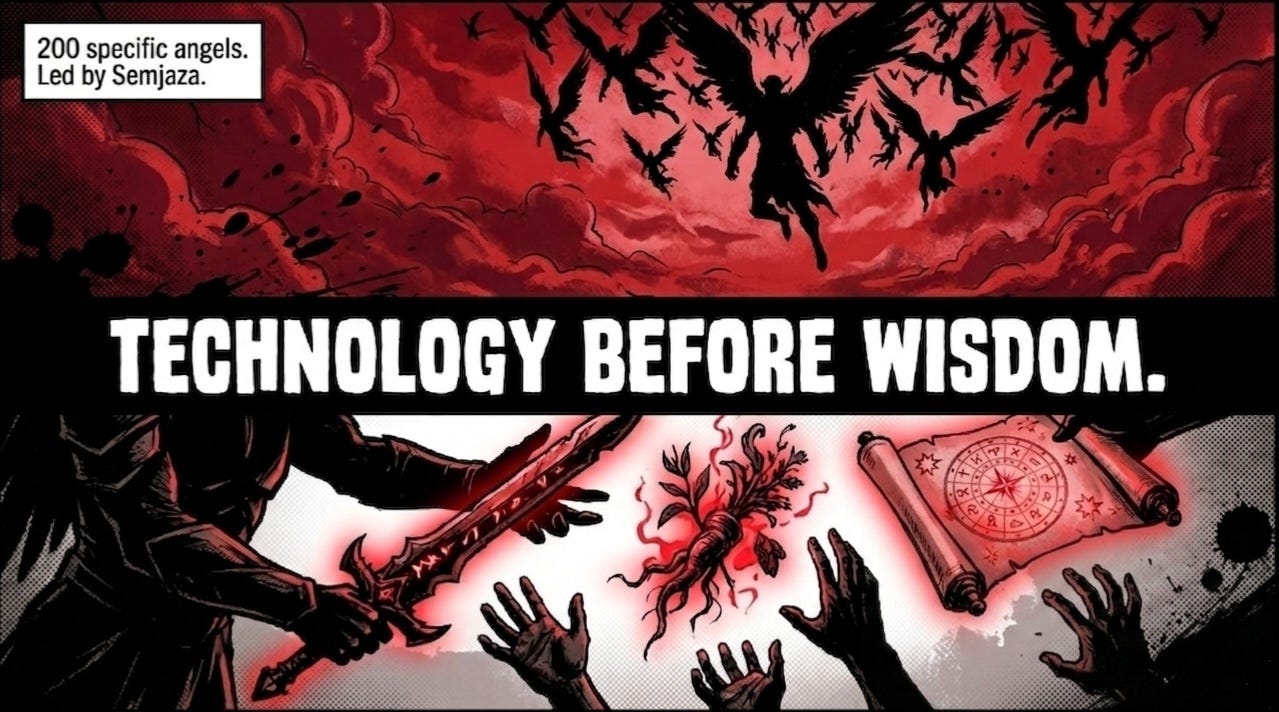
“And these are the names of their leaders: Semjaza, their leader, Arakiba, Rameel, Kokabiel, Tamiel, Ramiel, Danel, Ezeqeel, Baraqijal, Asael, Armaros, Batarel, Ananel, Zaqiel, Samsapeel, Satarel, Turel, Jomjael, Sariel. These are their chiefs of tens.”
The sons of God were angels. Specific angels. With names. Two hundred of them. Led by Semjaza. Genesis 6 calls them “sons of God.” Enoch 6 names them individually.
2: What did the sons of God actually do?
1 Enoch 7:1-5:
“And all the others together with them took unto themselves wives, and each chose for himself one, and they began to go in unto them and to defile themselves with them, and they taught them charms and enchantments, and the cutting of roots, and made them acquainted with plants. And they became pregnant, and they bare great giants, whose height was three thousand ells: Who consumed all the acquisitions of men. And when men could no longer sustain them, the giants turned against them and devoured mankind. And they began to sin against birds, and beasts, and reptiles, and fish, and to devour one another’s flesh, and drink the blood.”
1 Enoch 8:1-3:
“And Azazel taught men to make swords, and knives, and shields, and breastplates, and made known to them the metals of the earth and the art of working them, and bracelets, and ornaments, and the use of antimony, and the beautifying of the eyelids, and all kinds of costly stones, and all colouring tinctures. And there arose much godlessness, and they committed fornication, and they were led astray, and became corrupt in all their ways.
Semjaza taught enchantments, and root-cuttings, Armaros the resolving of enchantments, Baraqijal taught astrology, Kokabel the constellations, Ezeqeel the knowledge of the clouds, Araqiel the signs of the earth, Shamsiel the signs of the sun, and Sariel the course of the moon.”
The sons of God did not just intermarry. They taught. Metallurgy. Weapons manufacturing. Cosmetics. Divination systems. Astrology. Pharmaceuticals. Weather prediction. Root-cuttings (early pharmacology). They transferred technology before humanity had the wisdom to resist what the technology would produce.
Genesis 6 says they “took them wives.” Enoch 7-8 documents what happened after the union. The hybrid offspring consumed everything. When human resources ran out, they turned on humanity. And when humanity was depleted, they began consuming each other. Meanwhile, the Watcher fathers were teaching the corruption curriculum. Technology, enchantment, divination, violence, and beautification.
3: Why were the Nephilim a problem?
1 Enoch 7:3-5:
“And the giants turned against men and devoured mankind. And they began to sin against birds, and beasts, and reptiles, and fish, and to devour one another’s flesh, and drink the blood. Then the earth laid accusation against the lawless ones.”
The Nephilim were not just large. They were consuming. They ate everything. When the livestock was gone, they ate people. When people were gone, they ate each other. And they violated every categorical boundary in creation. Humans eating humans. Flesh eating flesh that was not assigned to it.
The earth itself responded. The ground cried out. The violation was not just moral. It was cosmic. Creation order was being systematically dismantled.
Genesis 6:11: “the earth was filled with iniquity” Enoch 7 documents what that “iniquity” looked like. Not human-scale war. Hybrid consumption and categorical boundary collapse.
4: How did the Nephilim survive the flood?
1 Enoch 15:8-12:
“And now, the giants, who are produced from the spirits and flesh, shall be called evil spirits upon the earth, and on the earth shall be their dwelling. Evil spirits have proceeded from their bodies; because they are born from men and from the holy Watchers is their beginning and primal origin; they shall be evil spirits on earth, and evil spirits shall they be called.
As for the spirits of heaven, in heaven shall be their dwelling, but as for the spirits of the earth which were born upon the earth, on the earth shall be their dwelling. And the spirits of the giants afflict, oppress, destroy, attack, do battle, and work destruction on the earth, and cause trouble: they take no food, but nevertheless hunger and thirst, and cause offences. And these spirits shall rise up against the children of men and against the women, because they have proceeded from them.”
The Nephilim died in the flood. Their bodies did not survive. But they were hybrids. Part angel, part human. When their bodies died, their spirits remained. Bound to the earth. Unable to rest. Disembodied and destructive.
These are the demons. The evil spirits the New Testament documents. Not fallen angels. Fallen angels are the Watchers, bound in chains. The demons are the disembodied Nephilim, still operating, still afflicting, still destroying.
Genesis 6:4 says “after that.” The Nephilim existed before the flood and after the flood. Enoch 15 explains how. Their bodies were destroyed. Their spirits continued. And when new hybrid creation occurred post-flood (which Genesis does not explain but Numbers 13 documents), the pattern repeated.
The Nephilim did not survive the flood physically. They survived spiritually. And the violation that produced them the first time was repeated in Canaan.
5: Why was the flood necessary if humans were the only problem?
1 Enoch 10:1-8:
“Then said the Most High, the Holy and Great One spoke, and sent Uriel to the son of Lamech, and said to him: ‘Go to Noah and tell him in my name “Hide thyself!” and reveal to him the end that is approaching: that the whole earth will be destroyed, and a deluge is about to come upon the whole earth, and will destroy all that is on it.’
And again the Lord said to Raphael: ‘Bind Azazel hand and foot, and cast him into the darkness: and make an opening in the desert, which is in Dudael, and cast him therein. And place upon him rough and jagged rocks, and cover him with darkness, and let him abide there for ever, and cover his face that he may not see light.’
And to Gabriel said the Lord: ‘Proceed against the bastards and the reprobates, and against the children of fornication: and destroy the children of fornication and the children of the Watchers from amongst men and cause them to go forth: send them one against the other that they may destroy each other in battle.’
And the Lord said unto Michael: ‘Go, bind Semjaza and his associates who have united themselves with women so as to have defiled themselves with them in all their uncleanness. And when their sons have slain one another, and they have seen the destruction of their beloved ones, bind them fast for seventy generations in the valleys of the earth.’”
The flood was not just about human wickedness. It was about cosmic rebellion. The Watchers were judged. Azazel was bound in darkness. The Nephilim were sent against each other to destroy themselves in battle before the flood waters came. Semjaza and the other Watcher leaders were bound for seventy generations.
The flood was the execution of a sentence passed on angels and their hybrid offspring. Human wickedness was part of the indictment. But Genesis 6:12 says “all flesh had corrupted his way upon the earth.” Not just human flesh. All flesh.
Enoch documents what that corruption was. Angels violating their estate. Hybrids consuming creation. Technology transferred before wisdom. Categorical boundaries systematically erased.
The flood was not Plan B because humans misbehaved. The flood was the reset required when the created order itself was dismantled by beings who knew exactly what they were doing.
Genesis 6 says the flood happened. Enoch 10 documents why it was the only solution.
If Enoch answers what Genesis raises, why is Enoch not in the Western canon?
Not because it contradicts Scripture. It explains Scripture. The early church fathers cited it freely for three hundred years. Jude quoted it directly as prophecy in the New Testament. The Dead Sea Scrolls contained more copies of 1 Enoch than most books in the Protestant Old Testament.
Enoch was not absent from early Christianity. It was removed from late Christianity.
Why?
The standard explanation: Enoch is too fantastical. Too apocalyptic. Not reliable. The councils examined it and determined it did not belong.
The forensic explanation: Enoch made institutional control unnecessary.
Genesis 6 becomes a four-verse puzzle with no answer key. The “sons of God” become undefined. The Nephilim become unexplained. The source of corruption becomes invisible. The post-flood Nephilim become impossible.
And when the text raises questions it does not answer, someone must provide the answers. That someone is the institution. The church. The authority structure empowered to tell you what Genesis 6 means because Genesis 6 does not tell you itself.
With Enoch, you do not need an interpreter. The text interprets itself. Genesis 6 summarizes. Enoch 6-10 expands. Read both and the questions answer themselves.
Without Enoch, you need someone to tell you what Genesis 6 means.
The Sethite interpretation became dominant not because it solved the textual problems, it became dominant because it avoided the implications the angelic interpretation carried. If angels can rebel, take form, and corrupt the earth, then the spiritual realm is more active and more dangerous than a controllable theology allows. If hybrids can be created and their spirits continue as demons, then the nature of evil is older and more complex than human sin alone.
The angelic interpretation, supported by Enoch, produces a cosmos the institution cannot fully manage. The Sethite interpretation produces a cosmos that stays within the boundaries the institution can explain.
Remove Enoch and you remove the text that makes the angelic interpretation undeniable. Keep Genesis 6 as a four-verse fragment and the questions never resolve.
The argument itself becomes the product. Not the answer, the argument. Sustained confusion creates a permanent market for expert management. The people qualified to manage the confusion become necessary. Because the text was arranged to require them.
The questions were not left unanswered because the answers did not exist. Enoch had the answers. They were left unanswered because a text that answers itself does not need an interpreter. And an institution without interpretive authority is just a building.
And the questions are still being argued two thousand years later.
The trail is short and it is all primary source.
Genesis 6:1-4. Read the four verses. Write down what they raise but do not answer.
Job 1:6. Job 2:1. Job 38:7. See how “sons of God” is used when Genesis is not involved.
Justin Martyr. Irenaeus. Clement. Tertullian. Athenagoras. Available online. See what three centuries of consensus actually said.
1 Enoch 6-10. R.H. Charles translation. Free online. Read what it says, not what someone told you it says.
See which of the five questions get answered.
I came to the same conclusion after reading the apocrypha, that they took out the so called lost books to confuse and for people to seek interpretation.
"Enoch is too fantastical. Too apocalyptic. Not reliable. The councils examined it and determined it did not belong." Could you please give a single instance where this statement is documented in any council? I must be overlooking something.