
The NT Translation Tier List
This list contains the best available English Bible translations for believers according to manuscript evidence and word-for-word translation methods. I will update it regularly.
The standard here is simple: how much does this translation let the original Greek speak, and how much does it let the translators speak instead?
Every departure from word-for-word is a committee inserting itself between you and the text. KC does not tolerate intermediaries between the reader and the source, not in canon, not in translation.
One question decides every placement: does this translation render what the Greek says, or does it render what the committee thinks the Greek means?
Those are not the same thing. The gap between them is where your theology gets quietly replaced.
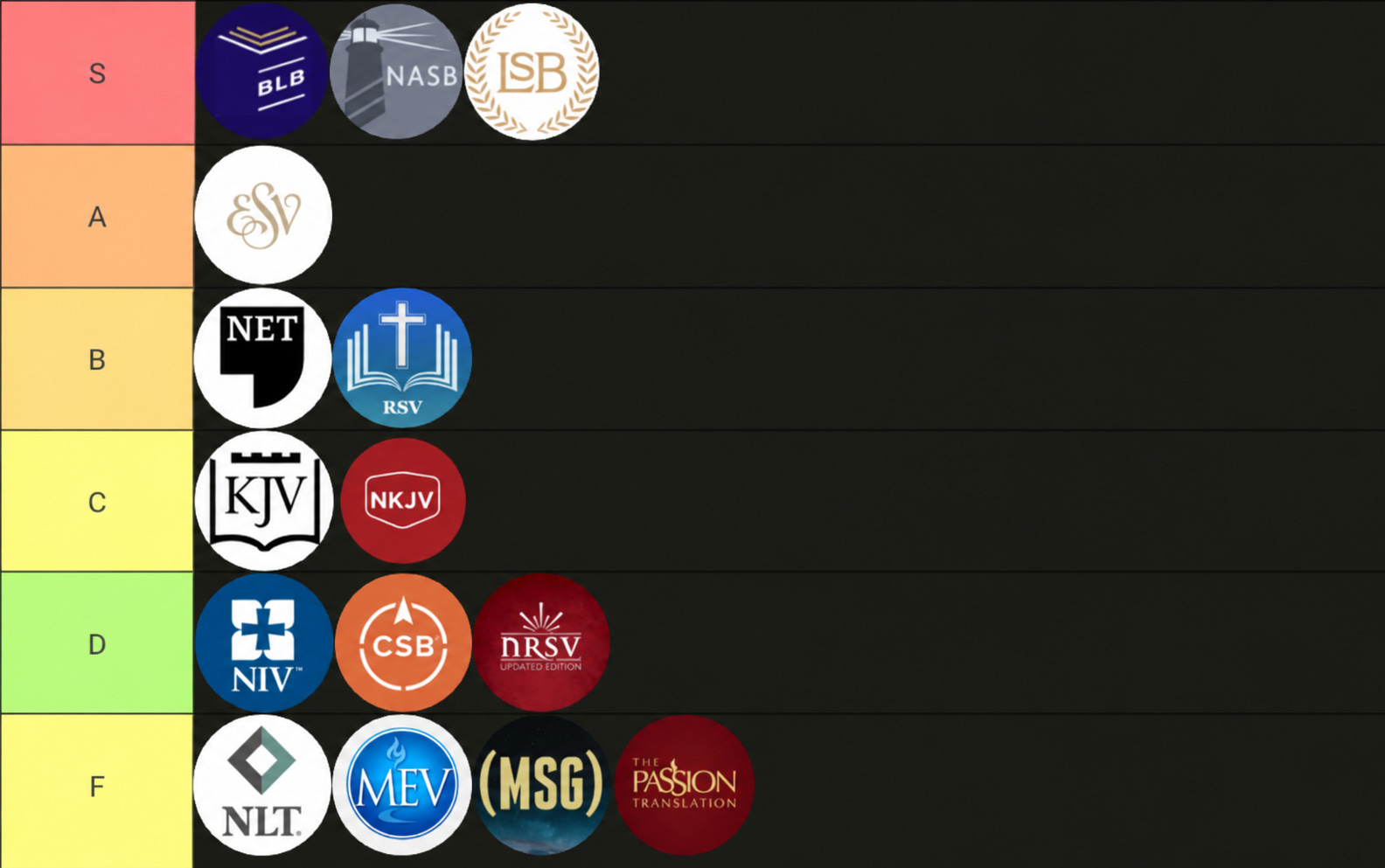
S-TIER
BLB (Berean Literal Bible)
The newest entry on this list and the one that earned its place under fire. When every major translation compromised on a single Greek participle, mellōn, present active, “about to come,” the BLB held the line. The NASB added words not in the Greek. The ESV rendered the tense idiomatically. The KJV softened it into background prediction. The NIV closed it in the past tense. The BLB rendered what the Greek says: “the one about to come.” Present. Active. Still in motion.
Word-for-word. Parts of speech matched as closely as possible. Tense, mood, and voice of verbs preserved. That is the stated standard, and the mellōn test proved it holds under pressure where others fold.
One more thing separates it from every other translation on this list: it is open-source. Anyone can comment, criticize, and suggest improvements. No denominational committee owns it. No institutional interest protects a bad rendering choice. The translation is accountable to anyone who reads Greek and finds a problem.
That is what a rock foundation looks like. You can push on it. It invites the pressure. It does not protect its conclusions from examination, it submits them to it.
Primary study tool. Sit it next to the NASB. Where they agree, you are standing on solid ground. Where they diverge, you now have a question worth investigating.
NASB 1995
The most word-for-word literal English New Testament in wide circulation. Formal equivalence: the translators rendered what the Greek says, not what they thought it meant. Except for certain verses shaped by assumptions inherited from Western tradition, but that is expected, since the theological foundation of the Western church itself is compromised. Still, the principle holds regarding the translation method. Preserves Greek verb tenses better than any other mainstream option, aorist, perfect, present continuous, distinctions that carry real theological weight. Built on the critical Greek text drawn from the oldest surviving manuscripts: Egyptian papyri dated around 200 AD, Sinaiticus and Vaticanus from the 4th century. Hard to read devotionally. That is the point. The text resists being slid past. This is your primary study tool.
LSB (Legacy Standard Bible)
More wooden-literal than even the NASB. The most uncompromising formal equivalence in Western publishing. Critical text base. If your goal is maximum proximity to the Greek without learning Greek, this is the closest available. Comes from John MacArthur’s seminary, that theological flavor surfaces occasionally in interpretive choices. Hold that awareness. The translation method itself is the tightest on this list.
A-TIER — Reliable, Know The Weaknesses
ESV
Formal equivalence. Critical text. Preserves Greek syntactic structures well. Strong for word-level study. Translated by a Reformed theological committee, that occasionally surfaces in rendering choices around grace and works passages. Minor but traceable. Still word-for-word where it counts. The most consistently literal of the mainstream options after the NASB and LSB.
B-TIER — Useful, Proceed With Awareness
NET Bible
The main text is mediating, it prioritizes readable English over strict literalism, which disqualifies it from the top under the KC standard. The reader reads the main text. Most readers never open the footnotes. However: the 60,000+ translator footnotes document every textual decision. When manuscripts disagree, the NET shows you what the oldest witnesses say, what the later ones say, and why the translators chose what they chose. No other English translation is this transparent about its own process. Use it alongside the NASB, not instead of it.
RSV
Aimed to be “as literal as possible,” which means it isn’t. Readability was a stated goal alongside literalism, which means the committee made judgment calls about when the Greek needed smoothing. Critical text base is solid. The translation method is a compromise. Useful for cross-reference alongside the NASB. Not your primary study Bible.
C-TIER — Wrong Foundation
KJV
The English is unmatched. The 1611 translators were among the finest prose stylists the language has produced. The problem is not the rendering, it is what is being rendered. Erasmus compiled the Textus Receptus in 1516 from late Byzantine manuscripts, some dating to the 12th–15th centuries. The KJV contains additions that are not in the oldest manuscripts: the Johannine Comma, the explicit trinitarian phrase in 1 John 5:7, absent from Sinaiticus, Vaticanus, and the Egyptian papyri; the Long Ending of Mark (16:9-20), absent from the two oldest complete codices; the woman caught in adultery (John 7:53–8:11), absent from the early Alexandrian witnesses. These are not disputed. They are documented. The KJV renders faithfully, but it renders a text that has already been altered at the source. That is the same deletion and addition problem KC names everywhere else. Use for rhetorical weight. Know what you’re holding.
NKJV
Updated the KJV’s English. Same Textus Receptus base, same problem. Marginally better than the KJV in that its footnotes acknowledge manuscript variants, the reader at least has visibility into the disagreements. Carries the same textual additions. Same C-tier placement for the same reasons.
D-TIER — The Committee Replaced The Text
NIV
The most popular English Bible in the world. The problem is stated in its own methodology: dynamic equivalence, thought-for-thought. The committee’s interpretation of what the text means replaces what the text says. That interpretive layer is invisible, the reader has no way to know where they are reading Greek and where they are reading the committee’s version of Greek. Theological smoothing happens at every point of friction. Individual word studies become unreliable because the English may not reflect the underlying Greek at all. Built on the critical text, which makes the methodology choice even harder to excuse. They had the right source and chose to filter it anyway.
CSB
Hybrid approach, formal equivalence where the committee judged it possible, dynamic equivalence where they judged it necessary. The problem: the reader cannot tell where the line falls. Interpretation is embedded at unmarked points throughout the text. The committee’s invisible judgment replaces the Greek whenever they decided the Greek needed help. That is not translation. That is editorial management dressed as translation.
NRSVue
Gender-inclusive language in places the Greek does not warrant it. That is a committee imposing a modern ideological preference onto an ancient text. The method is the same as dynamic equivalence, a decision is made that the text needs to say something other than what it says, and that decision is made invisibly. The Greek says what it says. The translator’s job is to render it, not to improve it.
NOT TRANSLATIONS
These do not belong in a translation ranking because they are not translations.
NLT
Paraphrase. The translators told you what they thought the text meant. Fine for introducing someone to the story. Not what you build doctrine on. Not a study tool.
MEV (Modern English Version)
Textus Receptus base like the KJV, same compromised manuscript problem, without the KJV’s English quality to justify the tradeoff. Gets the worst of both worlds.
The Message
Eugene Peterson wrote a cultural paraphrase, what he thought Paul would sound like writing for modern Americans. That creative interpretation is embedded in every verse. No Greek manuscript base was being followed. Some passages are illuminating as commentary. None of it is Scripture for study.
Passion Translation
Not a Bible with a theological slant. Theology wearing a Bible’s cover. Brian Simmons added words, phrases, and entire concepts not present in any Greek manuscript, then cited “Aramaic sources” that do not exist. Do not use.
Study the NT: NASB 1995 or LSB. These are the tools.
Cross-reference: ESV. NET footnotes alongside your primary.
Rhetorical citation: KJV, knowing the base is compromised at the source.
Everything in D-tier: You are reading the committee. Not the text.
Not Translations: Remove them from your shelf entirely.
The OT tier list is a different conversation, and a heavier one. That post is coming.
Thank you for this! It is really helpful!
You may be interested in reading the transline bible, https://literalnewtestament.com/get-it-free/ aka The Disciples Literal New Testament on Bible gateway. Transliterates words which aren’t found in English as hyphenated words. Nests paragraphs based on grammar.