
What Is a Disciple?
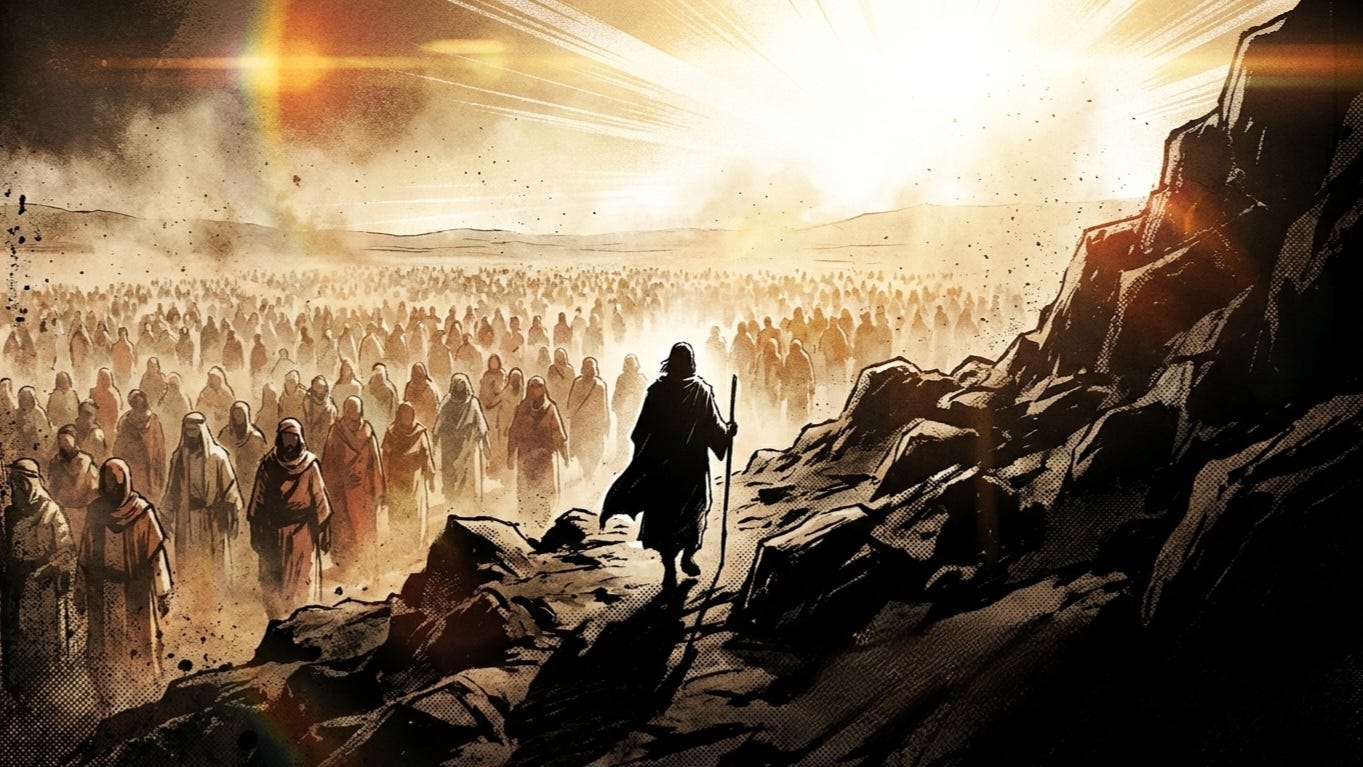
Jesus had crowds. He chose twelve.
Sit with that gap for a moment. Because the entire model of modern Christian discipleship, the platform, the funnel, the follow-up sequence, collapses inside it.
Luke 6:12 says He went up on a mountain to pray and spent the entire night there. Then, in the morning, He chose twelve.
Named individually. Called out of a larger body of disciples who were themselves already a narrowing from the crowds.
The selection cost something. An entire night. That detail is not decoration. The text wants you to feel the weight of the decision before it shows you the outcome. You don’t spend a night in prayer over a mailing list.
What Jesus built was not a proclamation operation. It was a narrowing, crowds to followers to twelve to three (Peter, James, John, who witnessed things the others didn’t) to one (John, at the cross, when the rest had scattered). Every degree of proximity cost more and held fewer people.
Matthew 13. The crowd is large. The disciples come to Him afterward with a reasonable question: why do you speak to them in parables?
His answer does not land the way modern Christianity tends to want it to.
“Because it has been given to you to know the mysteries of the kingdom of heaven, but to them it has not been given.”
Then he quotes Isaiah 6. Which is not a comfort passage.
“You shall hear indeed, but you shall not understand; and you shall see indeed, but you shall not perceive.”
Isaiah 6 is the commission God gives the prophet, go preach to this people so that they will not understand, will not perceive, will not turn and be healed. The concealment is the intention. Not a side effect of difficult material. The intention.
This is where the modern church-growth apparatus goes quiet, because it indicts the announcement model at the root. The word the Gospels use — parabolē in Greek — is not “illustration.” It’s closer to riddle. Enigma. A deliberate fold in the language that opens to some and closes before others, depending on what they bring to the hearing.
The announcement model assumes the problem is volume. Jesus assumed the problem was readiness.
Now look at the twelve.
Fishermen. Working Galileans whose calloused hands and regional accents marked them as amha’aretz, the ‘people of the land’ who sat well below the religious establishment’s baseline. They were already outside the religious establishment’s baseline before the day began. Matthew — Levi — handled Roman coin for a living, which made him a collaborator and a traitor to his own people in the same breath. Simon the Zealot was almost certainly committed to the violent removal of the same Roman apparatus Matthew served. These two men sat in the same inner circle.
Jesus did not choose people who had their piety composed. He chose people whose daily existence placed them in open contradiction with everything the religious establishment held as prerequisite. That’s not romantic. What they shared wasn’t doctrine, wasn’t credential, wasn’t clean hands. What they shared was willingness to leave, to drop a known life for an unresolved question.
Matthew 18:3: “And He said, ‘Truly I say to you, unless you change and become as little children, you shall not enter into the kingdom of the heavens.’”
The child doesn’t have the answers. The child hasn’t stopped asking. That’s the prerequisite, not certainty, but the particular hunger that makes a person willing to abandon what they have and follow something they cannot yet name.
The twelve dropped nets and tax booths. What they left behind tells you something about what they were moving toward.
Matthew 7:6. “Do not give that which is holy to the dogs, nor cast your pearls before swine, lest they will trample them with their feet, and having turned, they might tear you to pieces.”
Modern programmatic ministry has always been uneasy with this verse. Too severe. Too narrow. It doesn’t fit the announcement model’s assumptions, so it gets softened into a vague caution about spiritual rudeness.
But read it in sequence, after you know who Jesus chose, after you understand what the parable was doing. The warning isn’t about contempt. It’s about what happens to truth when it’s deposited somewhere that has no capacity to receive it. The swine don’t decline the pearls with regret. They trample them and come for you.
The danger isn’t to the pearls. It’s to the one who threw them.
Discernment about who is ready is not arrogance. It’s what Jesus practiced. He did not unfold the parables before the crowd. He unfolded them to the twelve, in private, when they asked. Access to the meaning was earned by the willingness to pursue it. The teaching doing exactly what it was made to do.
Luke 9:57-62 is the passage the announcement model prefers not to linger on.
Three people come to Jesus and volunteer. Initiate contact. Declare their willingness. By any ordinary measure of ministry, these are the names you want. Watch what He does with them.
The first says: “I will follow you wherever you go.” Jesus says: “Foxes have holes and birds of the air have nests, but the Son of Man has nowhere to lay his head.” No welcome. No orientation. A disclosure about what following actually costs.
The second, Jesus Himself calls, “Follow me.” The man says he’ll come once he has buried his father. Jesus says: “Leave the dead to bury their own dead.”
The third volunteers: “I will follow you, Lord, but let me first say farewell to those at my home.” Jesus says: “No one who puts his hand to the plow and looks back is fit for the kingdom of God.”
He turned all three back toward their own unresolved condition. Or handed each of them the one question they had to answer before the following could be real. The institution runs membership campaigns. Jesus ran the opposite, a sustained interrogation of whether the person standing before Him had truly counted what they were offering. Precision over volume, again, and now directed at people who came of their own accord.
You don’t build a movement that way. You build something else.
Matthew 25. A master leaves on a journey and distributes talents to three servants according to their capacity. Two trade and double what they were given. The third buries his.
When the master returns, the third servant explains himself. His own words are the indictment: “I was afraid, and I went and hid your talent in the ground.”
He knew the master. He made his calculation on the basis of that knowledge. Safety. Preservation. No exposure.
The talent wasn’t lost to failure. It wasn’t lost to sin. It was lost to fear dressed as prudence, to caution dressed as faithfulness, buried intact, returned undamaged, accompanied by a reasonable account of itself. The servant didn’t squander it. He protected it. Returned it precisely as he’d received it, untouched and therefore useless.
The master called it wicked and slothful.
He protected the deposit by eliminating the exposure. But in the economy of the kingdom, preservation is the first step toward elimination.
John 6. Jesus has just delivered the bread of life discourse, the hardest teaching in the Gospels, the one that sounds exactly like what His enemies would later accuse him of at trial. The crowd thins. Then it empties. “After this, many of his disciples turned back and no longer walked with Him.”
He lets them go. No clarification. He turns to the twelve.
“Do you also want to go?”
Peter’s answer is not a confession of triumphant faith. It’s a man who has exhausted his alternatives. “Lord, to whom shall we go? You have the words of eternal life.” That’s not conviction. That’s a person who has looked in every other direction and found nothing that holds. He isn’t persuaded. He is cornered by what he has already encountered, and honest enough to say so.
That’s the twelve. Already marked as outside, willing to follow a question they couldn’t resolve by remaining where they were, and now, when the path of least resistance opens before them, unable to take it. Because the encounter has already done something to them that cannot be undone.
Jesus had crowds. He chose twelve.
The question isn’t why so few made the cut. The question is what those twelve were doing that the crowd wasn’t.
More at [kingdomcodearchive.com]. Support the work on [Patreon].
I don't know if I have ever felt such kinship with the disciples as I do after reading your great essay.
Peter's response he gives when asked if they will also walk away really resonates with me. I finally turned to Jesus at 48 years old because I had taken most every other known path available. When the world calls me to return, I am not tempted. My temptation is void largely because of my faith, also because I know practically there is no other path; Jesus holds the answers to eternal life.
To follow or not to follow that is the question. Thanks for your work