
Which Hebrew
The Yavneh Floor
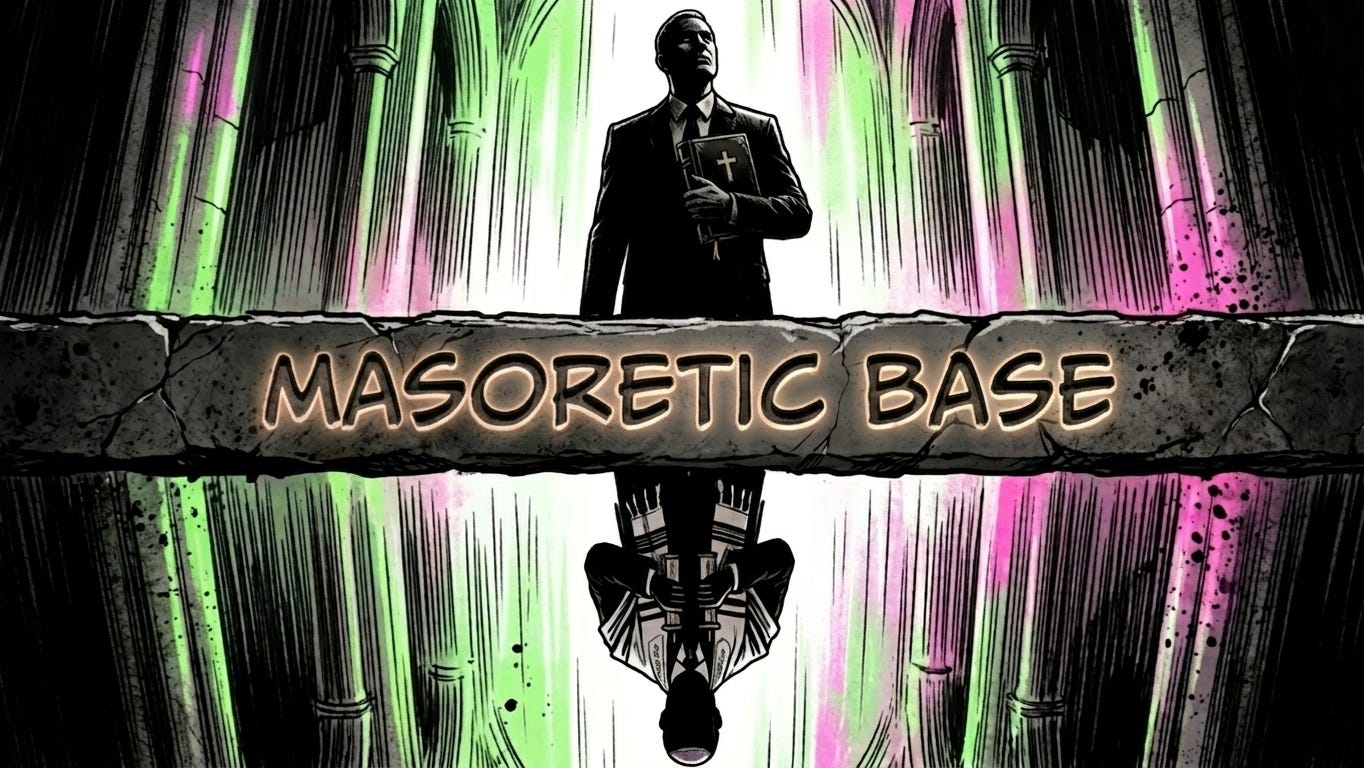
You did the work.
You went back when everyone around you stayed comfortable. You learned the divine names. You recovered the feast calendar. You stopped flinching at Torah and started reading it like it meant something. While the rest of the church was arguing about worship styles, you were asking harder questions about what actually got buried and who did the burying.
The question nobody asked you, the question you never thought to ask yourself, is: when you went back, what did you go back to?
Every argument inside Hebrew Roots circles about Scripture is an argument about translation. Which rendering captures the Hebrew. Which English word domesticates what the original preserved. Which version was shaped by Hellenistic theological assumptions and which one lets the text breathe in its own language.
The fight is always at the surface. The Hebrew underneath is treated as settled ground.
It is not settled ground. It is a construction. And the people who built it are the same people who decided what books belonged in the Bible.
The Hebrew text that sits underneath virtually every Torah-observant Bible translation in use today, the Tree of Life Version, the Complete Jewish Bible, The Scriptures, is the Masoretic Text. Most readers know this as a fact without knowing what it means.
The Masoretic Text was standardized by rabbinic scholars working in the decades and centuries after 70 AD. After the Temple fell. After the community fractured. During the same consolidation that produced what is commonly called the Yavneh canon closure, the process by which the rabbinic tradition settled which books belonged in Scripture and which ones didn’t.
Enoch didn’t make it. Jubilees didn’t make it. The books that carry the divine council in full resolution, the pre-Flood cosmology, the angelic agency that makes Genesis 6 and Deuteronomy 32 and Psalm 82 legible, none of them made it.
The same hands. The same consolidation. The text and the canon, shaped together, in the same historical moment, by the same tradition.
This is not a conspiracy. It is a traceable historical process. The question is whether you are willing to trace it.
The Dead Sea Scrolls were copied between roughly 250 BCE and 70 AD. They predate the Masoretic standardization by centuries. In critical passages they do not read the same as the MT.
Deuteronomy 32:8. One of the load-bearing texts in the entire Torah, the moment where the nations are divided and assigned. The MT reads: according to the number of the sons of Israel. The Dead Sea Scrolls read: according to the number of the sons of God.
This is not a translation variance. These are two different Hebrew manuscripts saying two different things. One places human population at the center of the division. The other places the divine council there, angelic beings set over nations, the ground from which the entire biblical territorial theology grows.
The Septuagint, translated from Hebrew source texts in Alexandria in the 3rd to 2nd century BCE, reads sons of God. The LXX translators were not working from the MT. They were working from a Hebrew tradition that predated it. And their Hebrew source said the same thing the Dead Sea Scrolls said.
Two ancient independent witnesses. Both older than the MT. Both preserving the divine council reading the MT quietly replaced.
When the oldest witnesses converge against the text you’re reading, the burden of proof does not rest with the older witnesses.
You left mainstream Christianity because you believed the authentic root had been buried. Rome narrowed the canon. Greek theology colonized Hebrew concepts. The divine names were replaced. The feast calendar was abandoned. The Torah was declared obsolete. You traced the burial and you started digging.
But the manuscript you are reading was shaped by the same consolidation that did the burying.
The Yavneh closure that excluded Enoch and Jubilees was not a separate event from the Masoretic standardization. It was the same tradition, the same period, the same post-Temple rabbinic consolidation working across both the canonical and textual questions simultaneously. The deletions in the canon and the softenings in the text came from the same source.
You Hebraized the vocabulary. You kept the Yavneh floor.
The books that were excluded, the ones that carry the divine council in full, that give Deuteronomy 32 its cosmic weight, that make the Genesis 6 incursion legible, that preserve the calendar theology Jubilees was specifically written to protect, those books were excluded by the same tradition that standardized the text you are using to recover from the exclusion.
You were digging through the ceiling of the archive that buried what you were looking for.
The King James-only tradition, the camp you left, the one you hold in open contempt for its Hellenized assumptions, its domesticated translations, its theological ceiling, is reading from the same Masoretic foundation.
Different aesthetic. Opposite cultural posture. Identical manuscript base.
The ancient witnesses that predate the Masoretic standardization do not converge randomly. The divergences cluster. The DSS, the Septuagint, and the Samaritan Pentateuch disagree with the MT most sharply in the passages that carry the divine council, the angelic agency texts, and the pre-Flood cosmology. These are not scattered translation disputes. They are a pattern. And patterns have causes.
The MT consistently softens exactly the passages that 1 Enoch and Jubilees illuminate in full. The cosmic frame collapses to the horizontal. The sons of God become sons of Israel. The Nephilim become mighty men of renown. The territorial theology loses its angelic depth. The calendar theology loses its cosmic anchoring.
The Ethiopian Orthodox church has preserved 1 Enoch and Jubilees in continuous canonical use for over fifteen hundred years. As Scripture, sitting in the same canon as Genesis, as Isaiah, as the Psalms.
This is the oldest surviving canonical witness to the most complete version of the story. And Ethiopia was outside both consolidations. Outside the post-Temple rabbinic closure. Outside the Roman narrowing that followed. The geographic isolation that Western scholarship sometimes treats as a mark of primitive provinciality is the precise reason the preservation happened. The archive that got sealed out of the metropolitan centers survived in the place the metropolitan centers couldn’t reach.
In passages where the canonical traditions diverge, the Ge’ez readings align with the DSS and the LXX against the MT. In some cases, with 1 Enoch most clearly, the Ge’ez is not a translation of a surviving original. It is the most complete surviving witness, period. There is no more original version to compare it against. The Ethiopian church kept what everyone else lost.
This is not a lesser tradition waiting for Western validation. The root that Hebrew Roots has been excavating toward exists. The stratum is just deeper than the one they’ve been digging in.
The question is which Hebrew. Standardized by whom. After which consolidation. With what removed, and why.
You went back. The work now is to go back further.

Is Messianic Judaism Restoring the Faith, or Reviving an Ancient Heresy?

This winter I went digging into the Hebrew Roots movement and its claims.
The truth is I couldn’t go back there was nothing there in the area I live in, but I kept doing my homework and really appreciate the work that you & many others have done to point the way to the truth.
This article makes a genuine and important observation before it goes wrong. The Masoretic Text is not a neutral, transparent window onto an original Hebrew Scripture. It is a product of a specific post-Temple rabbinic consolidation, standardized across centuries by a community that had formally rejected Jesus, and it does diverge from older witnesses at textually significant points. The Deuteronomy 32:8 example is real: the Dead Sea Scrolls and the Septuagint both read "sons of God" where the Masoretic Text reads "sons of Israel," and the convergence of two independent ancient witnesses against the later standardized text is a fact of textual scholarship that deserves serious attention rather than dismissal.
So far, so good. The problem is what Rocka does with this observation, and what he continues to omit.
The article is addressed to Hebrew Roots adherents, and its argument is: you left mainstream Christianity because Rome corrupted the tradition, but you went back to a Hebrew text shaped by the same consolidation that did the corrupting. This critique of the Hebrew Roots movement is largely correct. Rocka has made this point before, and it is a real one. But the way he frames the solution, a deeper excavation toward the Ethiopian canon and the Ge'ez tradition, carries the same structural flaw present throughout this publication's body of work.
Rocka writes that the Septuagint translators in Alexandria were working from a Hebrew source tradition that predated the Masoretic Text, and that their Hebrew source said the same thing the Dead Sea Scrolls said at Deuteronomy 32:8. This is accurate as far as it goes. What he does not tell his readers is that the Church recognized the Septuagint's significance and built its canonical and liturgical tradition substantially around it for centuries. Jerome translated the Old Testament portions of the Vulgate from the Hebrew, prompting a famous dispute with Augustine, who argued that the Septuagint carried its own inspired authority by virtue of its reception and use in the Church. That dispute was real, conducted by serious men, and it produced a Catholic tradition that has always held the relationship between the Hebrew and Greek textual traditions with more nuance than either the Protestant Reformers or Rocka's framework allows.
The Protestant translations Rocka names, the Tree of Life Version, the Complete Jewish Bible, The Scriptures, are not Catholic translations. They are productions of the Hebrew Roots and Messianic movements themselves, or of Protestant and parachurch publishers. The Vulgate, which the Catholic Church has preserved for over sixteen centuries as its foundational text, stands in a different relationship to the textual tradition than these translations do. Jerome knew the Masoretic tradition's limitations. He engaged the Septuagint throughout his scholarly life. The Church's Pontifical Biblical Commission has addressed questions of textual criticism in multiple documents across the twentieth century. These are not conversations the Catholic tradition avoided. They are conversations it has been having, with rigor, since the patristic period.
The Deuteronomy 32:8 example, the most compelling in the article, is worth following further than Rocka follows it. The "sons of God" reading, present in the Dead Sea Scrolls and the Septuagint, is also the reading preserved in the Catholic tradition through the Septuagint's influence on the Vulgate's Old Latin predecessors and through patristic commentary. Origen discussed the divine council texts. Augustine discussed them. Aquinas discussed them. The divine council cosmology Rocka presents as suppressed, as buried under Masoretic softening and Roman narrowing, was in fact never suppressed by the Catholic theological tradition. It was engaged, interpreted, and situated within a larger theological framework that the Church developed precisely because it took the full weight of the text seriously. The tradition that allegedly buried this material left extensive commentary on it, which is not the behavior of a tradition doing the burying.
The pattern Rocka identifies, that the Masoretic Text consistently softens passages carrying divine council, angelic agency, and pre-Flood cosmology, is a real and debated observation in textual scholarship. What he presents as a deliberate suppression campaign admits the same alternative explanation raised in response to prior articles: that scribal traditions make choices, that those choices cluster around theologically contested passages, and that the motive is not always demonstrable from the manuscript evidence alone. Post-Temple rabbinic Judaism had strong reasons to avoid texts that Christians were weaponizing in apologetic debate. That is a plausible motive for conservative scribal choices. It is not the same thing as a coordinated deletion campaign, and Rocka consistently narrates it as the latter.
The claim that in some cases the Ge'ez text of 1 Enoch "is not a translation of a surviving original" but "the most complete surviving witness, period" is presented as vindicating the Ethiopian canon's authority. But the absence of a surviving Hebrew or Aramaic original for 1 Enoch does not make the Ge'ez text the original. It makes it an unverifiable witness. We know from Qumran that Aramaic fragments of 1 Enoch existed. We do not have them in full. The Ge'ez translation is valuable. It is also a translation, made at a specific time, by specific translators, within a specific theological community, with all the traditioned character that entails. The logic that the Ge'ez text is authoritative because there is nothing older to compare it against is not a scholarly argument. It is an argument from the absence of contrary evidence, which is the weakest form of textual reasoning available.
The conclusion Rocka draws for his Hebrew Roots readers, that they went back to the wrong layer and need to go back further, leads them not toward the Catholic tradition that actually preserved the Septuagint's canonical authority, honored the deuterocanonical books the Protestant Reformers removed, and engaged the divine council texts in centuries of serious commentary. It leads them toward a paid Substack and an idealized Ethiopian canon whose distinctive books remain unattested outside the Ethiopian tradition itself.
The stratum Rocka's readers are looking for does exist. It is accessible. It does not require excavating past the Church that preserved it. It requires entering that Church and reading what it has always carried, including the seven deuterocanonical books absent from every Protestant Bible, including the Septuagint-influenced readings the Vulgate preserves, including two thousand years of commentary on precisely the texts Rocka presents as newly recovered secrets.
The dig is real. The direction is wrong.