
The Word They Use to Stop You From Reading
Apocrypha
You’ve heard the word. You know it has a warning label. Books you weren’t supposed to read, weren’t supposed to trust, weren’t supposed to treat as Scripture.
Ask the person using it what it means.
The conversation usually goes quiet.
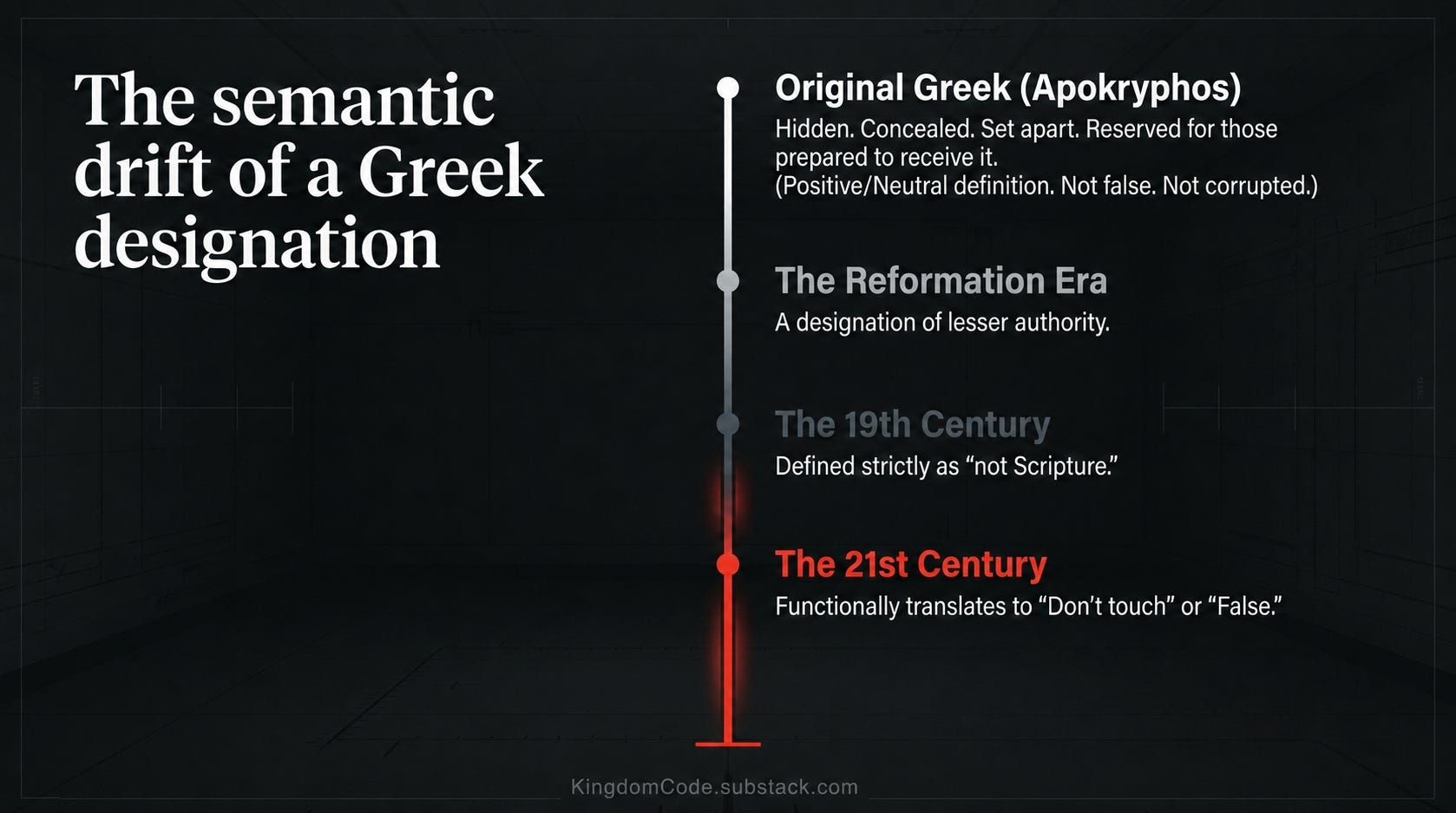
Apokryphos. Greek. Hidden. Concealed. Set apart.
Not false. Not heretical. Not corrupted. Hidden.
The shift from “hidden” to “false” happened gradually, through centuries of use by institutions that needed the word to do different work. By the Reformation it meant lesser authority. By the nineteenth century it meant “not Scripture.” By the twenty-first it means don’t touch.
The word didn’t change. The work it was assigned changed.
When someone says “that’s apocrypha,” they’re not making a historical claim. They’re making an authority claim. This text does not count. And if you ask them what apocrypha means, when the texts they’re labeling got that label, and who made the decision, most cannot answer.
The wall is built from bricks nobody has inspected.
Open a 1611 King James Bible. The original. Not a modern edition with the contentious parts removed.
Between the Old Testament and the New Testament, there’s a section titled “Apocrypha.”
Not in the back. Not in footnotes. In the Bible. Same pages, same type as Genesis and Matthew.
The translators didn’t hide it. They included it. They wrote in their preface that these books were “worthy to be read” for edification and instruction, even if not for establishing doctrine.
The 1611 KJV contained the Apocrypha for two hundred years. It was standard.
Then in the early 1800s, the British and Foreign Bible Society and the American Bible Society stopped printing it.
Printing costs were high. Removing the Apocrypha saved money.
Economic decision. Not theological one.
By 1826 it was disappearing. By 1885 it was rare. By the mid-twentieth century it was gone from most editions entirely.
When someone says “KJV only,” they are defending an editorial decision made by Bible societies trying to cut production costs. They are not defending the 1611 text. The 1611 text included what they’re rejecting.
The phrase is historically incoherent. Not provocative. Just incoherent.
Who decides what is apocrypha?
The Roman Catholic canon: seventy-three books. Tobit, Judith, Wisdom, Sirach, Baruch, 1 and 2 Maccabees, Scripture. Not apocryphal. Deuterocanonical.
The Protestant canon: sixty-six books. Those same seven, apocrypha.
Same texts. Different verdict. Depending on who’s holding the scales.
Luther called James an “epistle of straw.” Then he moved it, along with Hebrews, Jude, and Revelation, to the back of his New Testament. Unnumbered. Demoted. He didn’t remove them. He ranked them. Built a canon within the canon, with his theology as the measuring line.
A man who rearranges Scripture to match his doctrine is not submitting to the text. He is editing it. Editing is authority. Authority requires a mandate.
Where was the mandate?
The Ethiopian Orthodox Tewahedo Church canon: eighty-one books. 1 Enoch. The Book of Jubilees. 1, 2, and 3 Meqabyan. Not apocryphal. Scripture. The canon they have held without interruption since the fourth century.
Three traditions. Three different lists. Three different definitions of apocrypha.
When someone tells you not to read something because it is apocryphal, which tradition’s definition are they using? And why that one?
Rome drew the boundary to preserve texts useful for doctrines the Reformers rejected. The Reformers drew it to exclude texts Rome used as proof-texts. Ethiopia never moved it because their canon was settled before Rome and the Reformers ever disagreed.
Apocrypha is not a quality of the text. It is a statement of position. Move the boundary and the category changes.
The removal of Enoch and Jubilees from the Western canon happened in the fourth and fifth centuries. Councils met. Lists were debated. Texts were voted in or out because certain texts had become inconvenient.
The same councils that removed Enoch and Jubilees also debated Revelation, Hebrews, James, and 2 Peter. Those made it through by narrow margins. The criteria were not only textual. They were political.
Rome decided. The Ethiopian church, not under Roman jurisdiction, did not accept Rome’s decision. They kept Enoch and Jubilees. For sixteen hundred years.
The canon was not discovered. It was voted on. And different councils voted differently.
Now open the Book of Jude.
Canonical. Undisputed. In every Protestant, Catholic, and Orthodox Bible on earth.
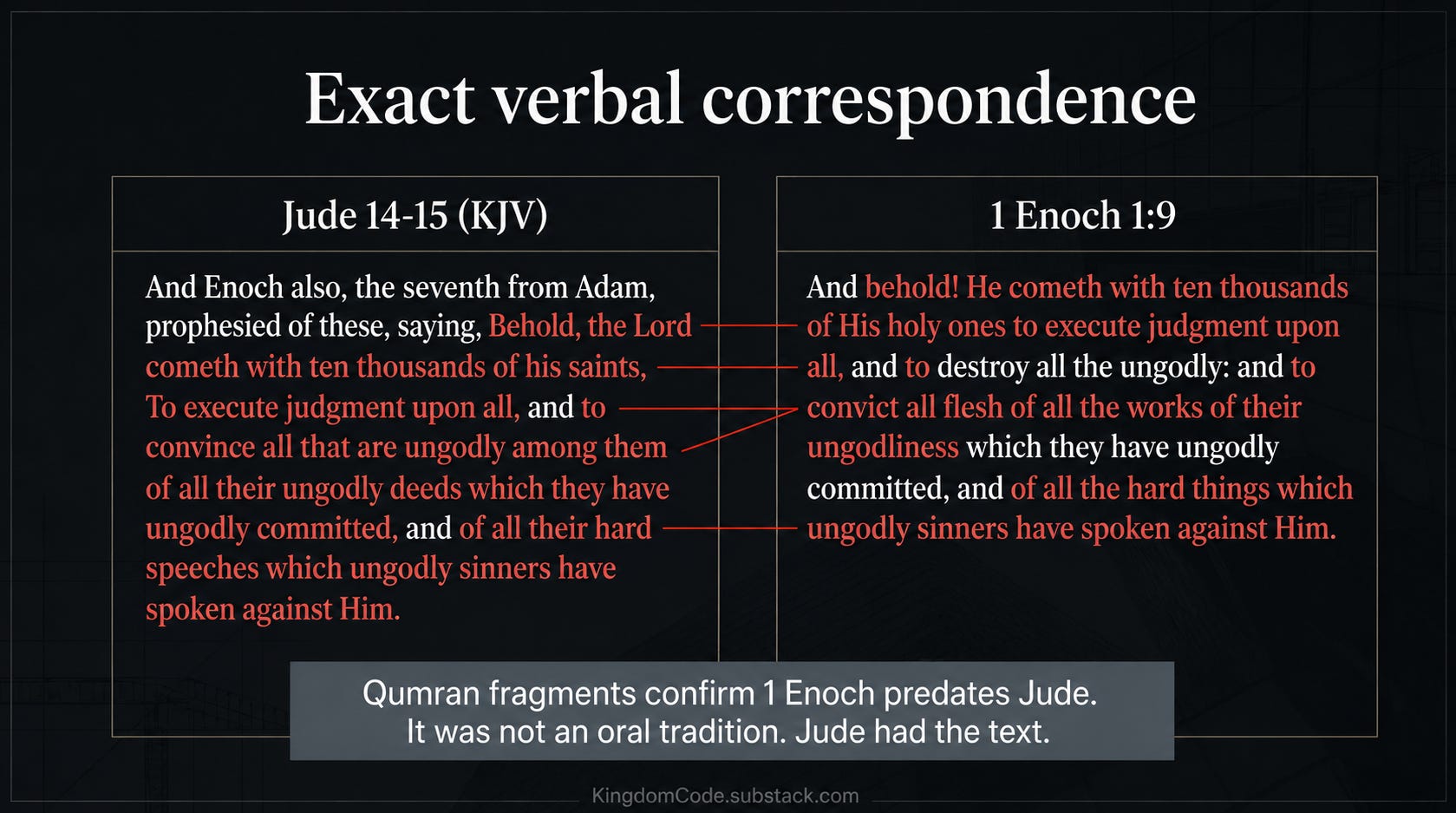
Jude 14-15. He is quoting 1 Enoch. Not paraphrasing. Not alluding. Quoting. Word for word. And he names the source: Enoch, the seventh from Adam, who prophesied.
A canonical New Testament writer cited 1 Enoch as prophecy. In Scripture.
If 1 Enoch is apocryphal, Jude quoted apocrypha as authoritative. If Jude’s citation makes 1 Enoch authoritative, it is not apocryphal.
Pick one.
The only exit is claiming Jude quoted oral tradition rather than a written text. But the verbal correspondence is exact. The structure matches. The phrasing matches. We have manuscript evidence of 1 Enoch predating Jude, fragments from Qumran, Aramaic copies. The book existed. Jude had access to it. He quoted it.
The people saying “no apocrypha” while holding a KJV that contains Jude 14-15 have not solved this problem.
They have ignored it.
The word means hidden. The usage means excluded. The exclusion was decided by councils whose criteria were not purely textual. The boundary sits in a different place depending on which tradition you ask. The texts on the other side were not proven false. They were voted out.
And Jude, already in your Bible, already quoted one of them.
The wall has been inspected. What you do with that is yours.
The original said Eusebius listed 1 Enoch as rejected. That was imprecise. His canon categories in Historia Ecclesiastica 3.25 were strictly for New Testament apostolic texts. 1 Enoch wasn't rejected by him, it wasn't on his list at all.
Which is actually the sharper point. By the fourth century, 1 Enoch wasn't even arriving at the Western sorting table. The exclusion was already inherited before the formal canon process ran. The councils didn't examine it and vote it out. They received a tradition that had already sidelined it and never questioned the inheritance.
Ethiopia never participated in that sidelining. The text stayed Scripture the whole way through.
The rest of the piece stands.
The missing puzzle that tells the rest of the story.
With the apocrypha the Bible is truly complete. You don’t need anyone’s help to help you understand the complete Bible.