
Before the King James Bible
A history of New Testament manuscripts — and the ground beneath your Bible
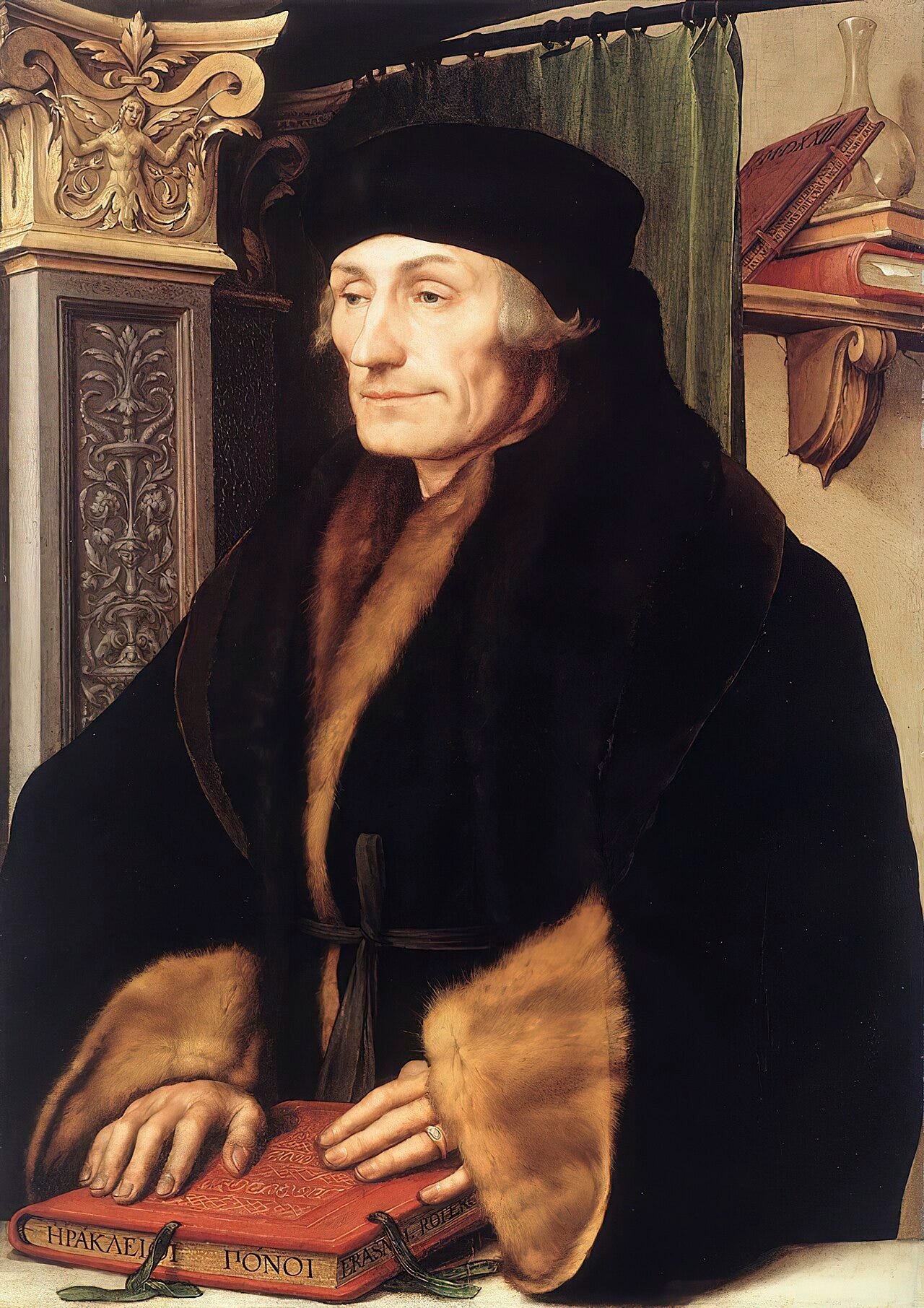
In 1516, a Dutch scholar named Erasmus published the first printed Greek New Testament. He left out a verse. First John 5:7, the one about the Father, the Word, and the Holy Ghost being one in heaven. He left it out because he could not find it in any Greek manuscript he examined.
He made a promise. If a Greek manuscript surfaced with the verse included, he would put it in.
A manuscript surfaced.
He put it in.
That manuscript, now called Codex Montfortianus, is widely believed to have been copied in the early sixteenth century for the specific purpose of fulfilling Erasmus’s condition. One scholar’s promise. One convenient manuscript. Five hundred years of a verse read from pulpits as bedrock.
We have been keeping his word for him ever since.
This is where the manuscript conversation begins. Not in the abstract. In a man keeping his word about a document that may have been manufactured to receive it.
The Text Before the Translation
Most readers never meet the text. They meet a translation of it. That is a different thing. The English sits on the page. Clean. Authoritative. Final. And below it, invisible, is a manuscript tradition that is older, messier, and more layered than the English suggests.
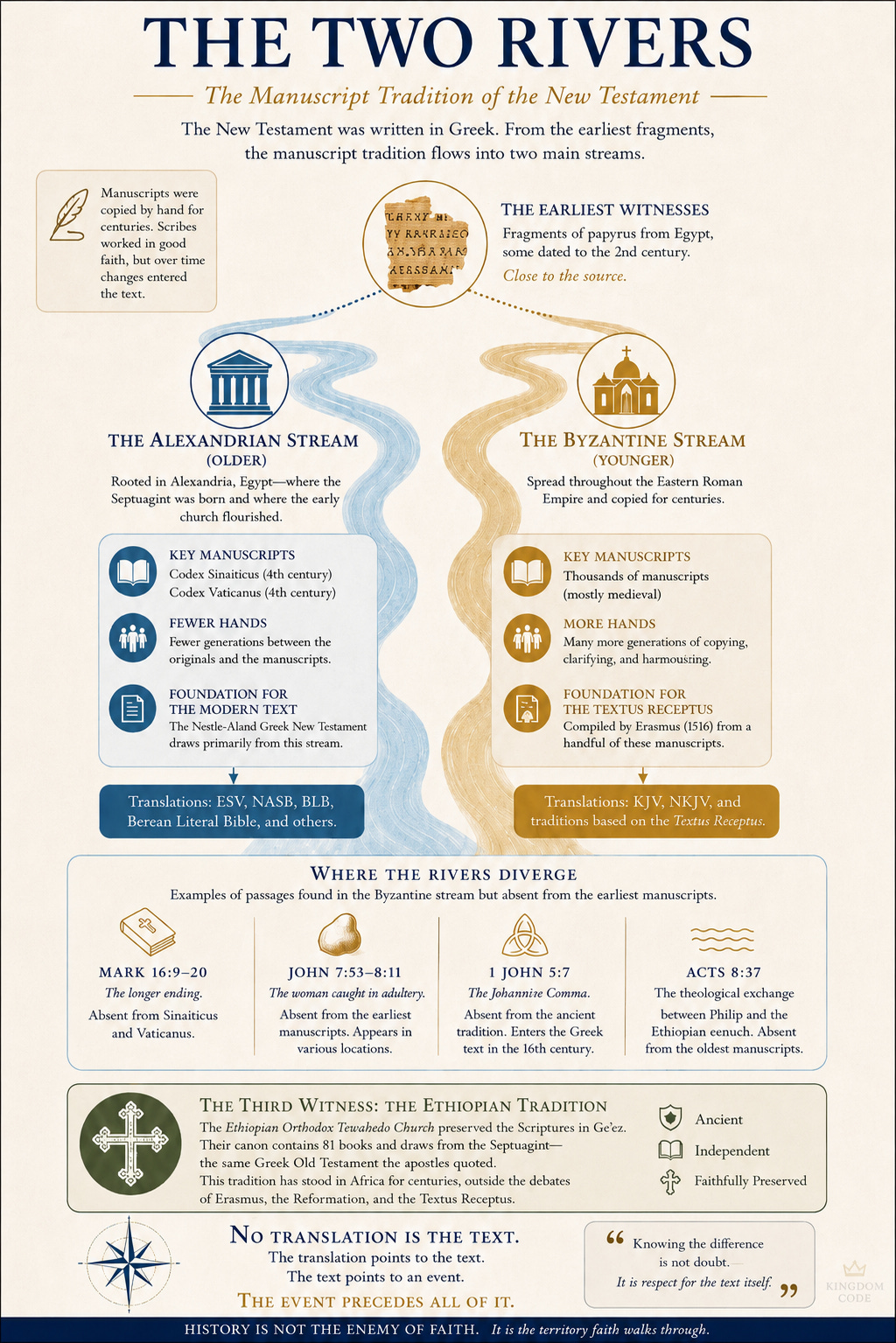
The New Testament was written in Greek. The letters of Paul, the Gospels, the Revelation of John, all Greek. The earliest manuscripts we possess are fragments. Scraps of papyrus from Egypt, some dated to the second century. Close to the source. Not the source itself, but close.
From those fragments forward, the manuscript tradition divides into two rivers.
The Alexandrian stream.
The oldest substantial manuscripts come from Egypt. Codex Sinaiticus, discovered at Saint Catherine’s Monastery on the Sinai Peninsula in the nineteenth century. Codex Vaticanus, held in Rome, written around the same era. Both dated to the fourth century. Both representing a text tradition rooted in Alexandria, the same city that produced the Septuagint, the Greek Old Testament that Jesus and the apostles quoted.
Fewer hands between these manuscripts and the original letters.
The modern critical text, refined into what scholars call the Nestle-Aland, draws primarily from this stream. Translations like the ESV, NASB, and the Berean Literal Bible sit on this ground.
The Byzantine stream.
Across the Eastern Roman Empire, the church copied and recopied the Scriptures for centuries. These manuscripts are more numerous, thousands of them. But they are younger. Medieval. A thousand years of copying, harmonizing, clarifying.
The Textus Receptus, the “Received Text” — was compiled from a handful of these manuscripts by Erasmus in the sixteenth century, refined slightly by later editors. This became the foundation for the King James Version in 1611.
The difference between the two streams is not a conspiracy. It is the normal history of ancient documents. Texts age. Texts spread. Scribes copy. And scribes, working in good faith, every one of them, occasionally add a word for clarity. A phrase for completeness. A verse for doctrine.
The question manuscript scholars ask is not who was evil. It is simply: what pattern do errors follow? Do words drop out over time, or do words accumulate?
The evidence runs toward accumulation.
Where the Rivers Diverge
Mark 16:9–20
The longer ending, snake handling, speaking in tongues, the Great Commission as commonly quoted. Absent from Sinaiticus and Vaticanus. Present in the Byzantine tradition. The KJV includes it. Most modern translations include it with a footnote noting its absence from the earliest manuscripts.
John 7:53–8:11
The woman caught in adultery. “Let he who is without sin cast the first stone.” One of the most beloved passages in the Gospels. Does not appear in the oldest manuscripts. It floats, appearing in different locations across different manuscripts, including once inserted into the Gospel of Luke. The KJV includes it. Modern translations include it with a note.
1 John 5:7
The Johannine Comma. The Father, the Word, and the Holy Ghost in heaven. Absent from every Greek manuscript before the sixteenth century. Absent from the Peshitta. Absent from the earliest Latin manuscripts. Enters the Greek text through Erasmus. The KJV includes it as Scripture. Modern critical texts omit it.
Acts 8:37
Philip and the Ethiopian. The theological exchange — “If thou believest with all thine heart, thou mayest” — is absent from the oldest manuscripts. It appears to have been added to demonstrate proper baptismal practice. The KJV includes it. Modern critical texts omit it entirely.
These are not minor variations in spelling. These are verses. Passages. Entire exchanges.
What the Translators Knew
Here is what the KJV-only tradition does not tell you.
The translators of the King James Bible knew they were not producing a final text. They said so themselves.
In the original 1611 preface, “The Translators to the Reader” — they wrote that a variety of translations is profitable for the finding out of the sense of the Scriptures. They cited translations before theirs. They argued against the idea that any single version should be treated as infallible above all others. They were scholars. They knew what a manuscript was. They knew what a translation was.
The doctrine that the King James Version is the perfect, preserved, final, infallible Word of God was not written by the King James translators. It was written later. By their disciples. Who, it appears, did not read the preface.
Large portions of the King James Bible were inherited directly from Tyndale’s earlier English work. The translators were revisers as much as translators.
The Ground That Was Always There
While the West spent five centuries arguing over two manuscript rivers, Byzantine versus Alexandrian, Received Text versus Critical Text, KJV versus everything else, there has been a third tradition standing in Africa the entire time.
The Ethiopian Orthodox Tewahedo Church preserved the Scriptures in Ge’ez. Their canon contains eighty-one books. Their textual tradition draws from the Septuagint, the same Greek Old Testament the apostles themselves quoted. Their manuscript history did not pass through Erasmus. It did not pass through the Textus Receptus. It did not pass through the politics of the Reformation.
It was simply there. Copied. Preserved. Read.
Christianity was present there long before the Reformation, long before the King James translators, and long before modern Protestant debates over the Textus Receptus and critical texts ever began.
The Church was already reading the same canon in the same language within the same liturgy it had preserved for centuries before those arguments emerged.
The conversation about which Bible is perfect has been, largely, a Western conversation about Western manuscripts and Western translations. That conversation has its place. But it has consistently forgotten that the faith did not originate in the West, was not preserved only in the West, and does not stand or fall on what one Dutch scholar included in 1516.
No translation is the text. The translation points to the text. The text points to an event. The event precedes all of it.
The manuscripts matter because they are the closest material witnesses we have to that event. When a manuscript is younger, copied more times, and carries verses that older witnesses do not, it is proof that the document has a history.
History is not the enemy of faith. It is the territory faith walks through.
The question is whether you know what your Bible is, and what it is not.
Knowing the difference is not doubt.
It is respect for the text itself.
Thank you. Compelling. This is great work.🙏
As you may be aware, recently I have been participating in discussions here on Substack involving the Septuagint, Vetus Latina, Vaticanus, Vulgate, Hexapla, Textus Receptus, and the "two streams" overview which you present in this Article.
My question is simple. If these following mss (codices) fit into either of these streams, where might they be located in the translation chronology ... other than by just dates?
PARTIAL LIST: Eastern Aramaic Text of The New Testament, in manuscripts such as The Yonan Codex, The Khabouris Codex, The 1199 Houghton Codex, and The Mingana 148 Codex,
MORE: BFBS/UBS Text of the 1905/1920 Aramaic New Testament, which is said to be a Critical Text of about 70 to 80 Aramaic Manuscripts, consisting of both the Eastern and Western versions, and also the 5th-6th century Aramaic Manuscripts housed in the British Museum, numbered 14,470, 14,453, 14,473, and 14,475.
In other words ... "... the manuscripts consulted for the actual translation are various 5th-6th century manuscripts, like the Goodspeed MS 716, manuscripts no.17 & no.54 from Saint Catherine's Monastery, 7th century manuscripts like The Yonan Codex, 8th-9th century manuscripts like the Paris Syr. 342 Codex, 10th-11th century manuscripts like the Vat.510 manuscript, and The Khabouris Codex, 12th-13th century manuscripts like the 1199 A.D. Houghton Codex, and the 1261 A.D. Syr. 9 Codex manuscript, and lastly the 1613 A.D. Mingana Codex which is known as "The Textus Receptus" of The Eastern Aramaic New Testament. ..."
ONE ONLINE SOURCE: https://www.thearamaicscriptures.com/index.html
This is amazing! Stuff like this will make a good theologian out of anyone! Great article and look forward to more!