
Elijah Is Still Coming

One word in the Greek. One rendering decision. And a prophecy that Jesus held open gets declared fulfilled.
“And, behold, I will send to you Elijah the Tishbite, before the great and glorious day of the Lord comes.” (EOB)
One sentence. One man. One day. But which day?
Malachi 4:1:
“For behold, a day comes burning as an oven, and it shall consume them; and all the aliens, and all that do wickedly, shall be stubble: and the day that is coming shall set them on fire, says the Lord Almighty, and there shall not be left of them root or branch.” (EOB)
A day burning as an oven. Aliens and evildoers consumed as stubble, root and branch. That is not the first coming. That is the final reckoning. And Elijah comes before that day, before the burning, before the accounting that ends the age.
The promise is clear. The timeline is not. The ambiguity is not an accident.
Matthew 11:14:
“And if you are willing to accept it, he is Elijah who is to come.”
One word determines everything: μέλλων. Mellōn. Present active participle of mellō.
Mellō carries the weight of imminence in first-century Greek. Not “who was predicted long ago and has now arrived.” About to. The action pressing toward the moment from the near future. Mellōn ercheshthai: the one being about to come. The participle is active and present — it does not describe an arrival already accomplished. It describes an arrival in motion.
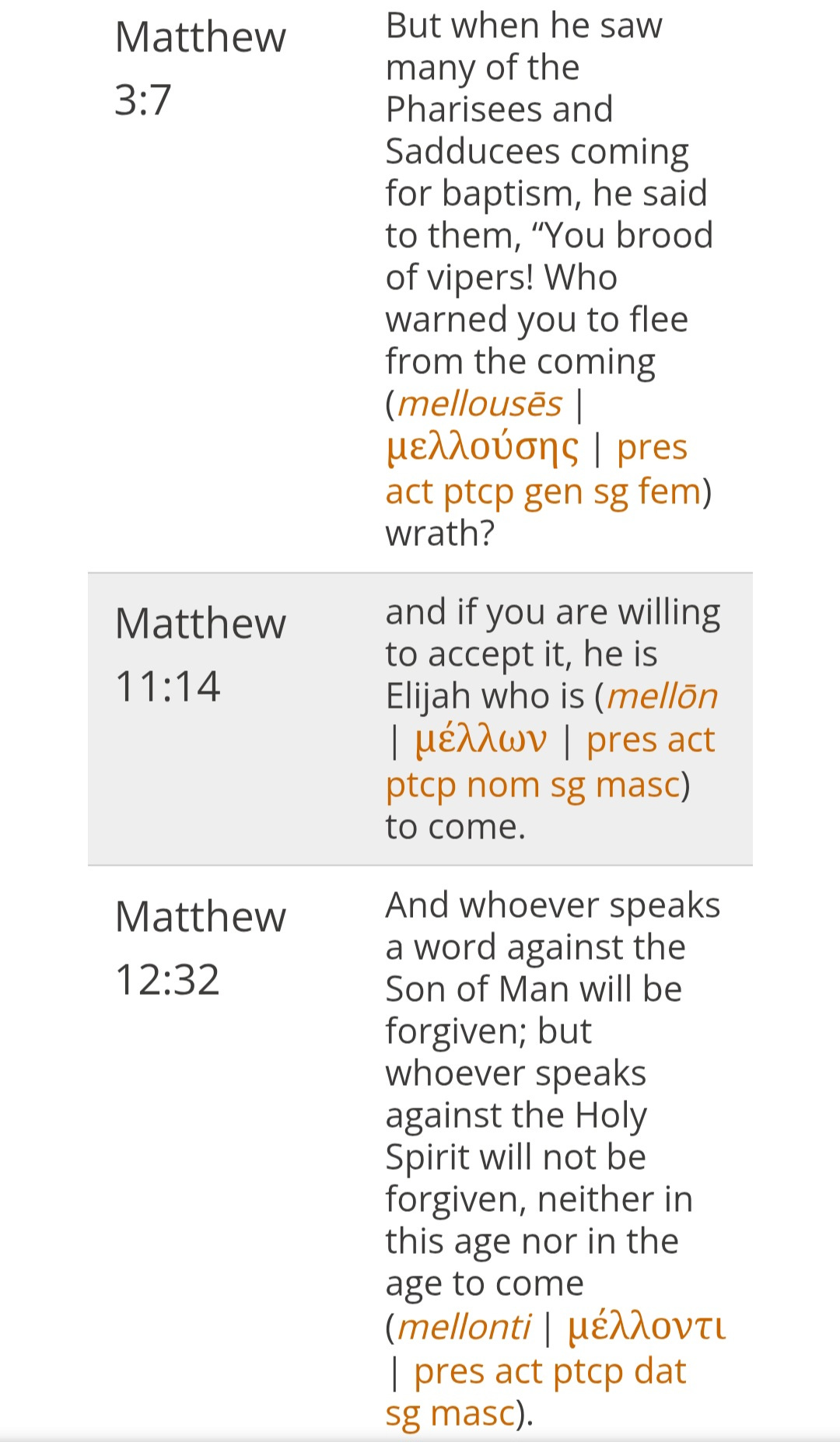
Matthew uses this consistently. Matthew 3:7: the wrath about to come (mellousēs orgēs). Matthew 12:32: the age about to come (mellonti). The participial form signals what is pressing toward the present, not what has already resolved.
In Matthew 11:14, Jesus says John is the Elijah who mellōn, who is about to come. Not who has come. Not who was promised and is now here in final fulfillment. The one in the process of coming.
Then Matthew 17. Same disciples. Different mountain. They have just seen Moses and Elijah standing with Jesus. Coming down, they ask: why do the scribes say Elijah must come first?
Jesus answers in both directions at once:
“Elijah does come, and he will restore all things. But I tell you that Elijah has already come, and they did not recognize him, but did to him whatever they pleased.”
Elijah does come. Future tense, present certainty. And: Elijah has already come. Past tense, past event.
Jesus holds both. At the same time. In the same breath. To the same disciples. He does not resolve the tension. He does not say: never mind the future, John has settled the question. He says both.
That is the ground. Whatever interpretation follows must account for both.
Now return to Malachi. If mellōn is rendered honestly, if the prophecy stays open at the moment of Jesus’s utterance, then Malachi 4:5 has not closed. The great and terrible day has not yet come. The furnace has not yet burned. The one who must come before it: still coming.
The translations chose otherwise.
The NASB adds two words not present in the Greek: John himself. Matthew 11:14 in Greek: αὐτός ἐστιν Ἠλίας ὁ μέλλων ἔρχεσθαι. Literally: he is Elijah, the one being about to come. The subject is αὐτός, he, a pronoun. John has been the referent of the preceding sentences. The Greek does not name him again. It doesn’t need to.
No brackets. No footnote. No signal to the reader that a choice has been made, that the translators moved from rendering the Greek to resolving a question the Greek leaves open.
The addition is not neutral. The Greek says he is Elijah, the one being about to come.
Matthew 11:14: “αὐτός ἐστιν Ἠλίας ὁ μέλλων ἔρχεσθαι”
The NASB says John himself is Elijah who was to come. One leaves the door standing. The other closes it and names who walked through it.
The other major translations follow the same road, only less explicitly.
KJV: “this is Elias, which was for to come.” The archaic English softens the participle into background prediction.
ESV: “he is Elijah who is to come.” Who is to come functions idiomatically in English as a completed category, the anticipated one, now arrived.
NIV: “he himself is the Elijah who was to come.” Past tense. The arrival is finished.
The Berean Literal Bible alone holds the line: “he is Elijah, the one about to come.” Present active participle. About to. Still in motion.
That is not a translation preference. That is what the Greek says.
Elijah never died. He went up in a whirlwind. A chariot of fire. 2 Kings 2:11. Scripture is meticulous about deaths, patriarch after patriarch, the record kept, and it has no death for Elijah. And no death for Enoch. Genesis 5:24: God took him. Two bodies kept. Two men who never crossed the threshold.
Hebrews 9:27: it is appointed for man to die once.
Elijah has not died once. Enoch has not died once. The appointment has not been kept.
Revelation 11 places two witnesses at the end of the age. Sackcloth. Three and a half years. Fire from their mouths that devours enemies. Power to shut the sky so no rain falls during the days of their prophecy. Power over waters, turning them to blood.
Elijah shut the rain. Three years and six months. 1 Kings 17-18.
The man who shut the rain never died. And in Revelation 11:12, when the witnesses have finished their testimony, they are taken up into heaven in a cloud as their enemies watch. The appointment, kept at last. What was deferred through the whirlwind, completed in the final hour.
If the Elijah prophecy had closed in the first century, there would be no need for what Revelation 11 shows. But it is there, in the final book, at the final hour, doing what Elijah did, and dying what Elijah never died.
The removal here is not a book. It is a tense.
Enoch was removed because it names where the corruption enters. Jubilees was removed because it ties covenant timing to a calendar Rome could not use. The Shepherd was removed because it made repentance harder than absolution. Here the move is smaller but the wound is the same: what the text leaves open, the rendering closes. What Jesus held in tension, the translation resolves. What the Greek says is still in motion, the English says has already arrived.
This is why translation dependence is a trap. You do not need a commentary. You do not need a teacher who explains what the translators meant when they made the choice they made. You need the closest text to the original you can get your hands on, the Greek, the Hebrew, the Ethiopic.
Read the Word as it was written, not through thought-for-thought translations or any other translation decisions that try to “clarify” the meaning for you.
Western scholars know the Greek. They are not stupid men. Mellōn is not a difficult participle, any first-year student reads it correctly. The closed reading is not an accident of ignorance. It is a choice that costs nothing and controls everything.
Ask yourself why this passage, Malachi’s final word, Jesus’s dual-tense answer, the only prophecy where Christ holds future and past in the same breath, does not get preached from Western pulpits.
An open door is harder to administrate than a closed one.
Enoch named authorities who alter the words of righteousness in many ways. Not always by excising books. Sometimes by choosing the wrong tense.
The Greek says about to.
The translations say already.
One of them is reading Malachi. The other is protecting a theology.
I have for some time been of the view that the great burning that follows the day of destruction (when the towers fall) is described in some detail in Isaiah 30 verses 25 to 30.
Does any of this have implications of "the spirit of". I'm not a Christian theologian and just came to Christ 3 years ago. So, please excuse any imprecise terms I might use.
When I read, "He is Elijah, the one who is to come." what comes to my mind is that He is in possession of the spirit of Elijah. He is doing the work of Elijah.
We know that God works through people. So given that, it's possible for God to work through Person A in the same way that he worked through Person B. Right?
And when that happens, as humans, we associate the actions of Person B with Person A because Person A was known first.
Yet to God, He is just doing His work in the way he always has. Through those who believe in and are obedient to him.
Is any of this making sense? Is some of this perhaps where the translators might have been confused or misdirected because they refuse to consider this larger spiritual perspective of how God works?